Petroglyphs Found in Kasaragod Temple Pond
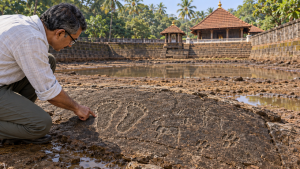
Petroglyphs depicting two human footprints and several animal tracks became visible as water levels fell in the pond at Adakkath Bhagavathy Temple in Bedadukka, Kasaragod. The discovery was reported on 22 January 2026.
Identification and estimated age
Historian Dr Nandakumar Koroth, a history researcher and lecturer at Nehru College, identified the rock carvings during a visit to the site. They are believed to date to the Mahashila (Megalithic) period and are estimated to be about 2,000 years old.
Important Facts for Exams
- Engraving and painting: In scholarly usage, a petroglyph is an engraving, whereas a petrograph or pictograph is a painting on rock.
- Imaging shallow engravings: Reflectance Transformation Imaging reveals shallow rock engravings by computationally combining photographs of the same surface lit from multiple directions.
- Megalithic burial diversity: In South Indian archaeology, “Megalithic” commonly denotes a funerary complex involving varied stone-marked burial practices, rather than one uniform monument type.
Originally written on
January 22, 2026
and last modified on
November 19, 2026.
| Related | |
|---|---|