North Western Ghats Gains Caecilian Biodiversity Hotspot Status
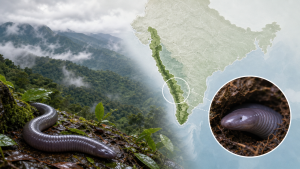
The Northern Western Ghats in Maharashtra added a new subterranean amphibian species, Gegeneophis chandgadi, from the Kolhapur region in September 2026. The discovery placed the North Western Ghats among important Indian localities for caecilian diversity, a group of legless amphibians that live underground.
Caecilians and Their Classification
Caecilians belong to the order Gymnophiona within class Amphibia. They are limbless, burrowing amphibians and are often mistaken for earthworms or snakes because of their cylindrical bodies and underground habits. India records 42 caecilian species among 458 amphibian species.
Discovery of Gegeneophis chandgadi
Gegeneophis chandgadi was found in Buzawade village in the Chandgad area of Kolhapur district, Maharashtra. The species was identified by a multi-institutional team from the Zoological Survey of India Western Regional Centre, Pune, Yashwantrao Chavan Mahavidyalaya, Savitribai Phule Pune University, and the Mhadei Research Centre, Goa. The species name refers to the Chandgadi dialect of Marathi spoken in the region.
Western Ghats as a Centre of Endemism
The Western Ghats is a UNESCO World Heritage Site and one of the world’s eight “hottest hotspots” of biological diversity. India has 12 species of the genus Gegeneophis, and 11 of them are endemic to the Western Ghats. The Western Ghats also hosts 26 endemic caecilian species.
Important Facts for Exams
- Gegeneophis chandgadi is a legless amphibian species discovered in the Northern Western Ghats of Maharashtra.
- Gegeneophis valmiki was discovered earlier in January 2026 on the Valmiki Plateau in Satara district, Maharashtra.
- The journal Phyllomedusa published the findings on Gegeneophis valmiki.
- Globally, 41% of amphibian species are threatened with extinction.
Conservation Context
Caecilians are difficult to study because they live underground and are rarely seen on the surface. The Zoological Survey of India has linked such discoveries with the documentation of species that may face “silent extinctions” in fragmented habitats.
| Related | |
|---|---|