New Begonia Species Described from Arunachal Pradesh
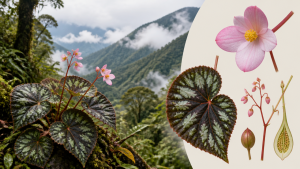
A new Begonia species, Begonia neelamorum, was formally described from Keyi Panyor district in Arunachal Pradesh on 24 September 2026. The species was collected on 24 May 2026 from steep, moist walls along the Keyi River at an elevation of about 1,000 metres.
Begonia as a Plant Group
Begonia is a large genus of flowering plants in the family Begoniaceae. The genus includes herbs, shrubs, and climbers, and many species occur in humid tropical and subtropical habitats.
Features of Begonia neelamorum
Begonia neelamorum is a small plant, 10–20 cm tall, with a single sessile light-green leaf. It has distinctive double-serrated margins and glandular hairs, which are used as diagnostic characters in plant taxonomy.
Discovery and Naming in Arunachal Pradesh
The research team included botanist Dipankar Borah from Kaliabor College in Nagaon, Assam. The species was named after the Neelam clan of the Nyishi tribe, which assisted the researchers during the expedition, and its local name is Kobiirhopu Baabrai.
Important Facts for Exams
- Begonia neelamorum was described from Keyi Panyor district in Arunachal Pradesh on 24 September 2026.
- The specimen of Begonia neelamorum was collected on 24 May 2026 near the Keyi River at about 1,000 metres elevation.
- Begonia nyishiorum was published in the journal Novon on 23 June 2025 and is endemic to East Kameng district.
- Begonia Chowna Buku Chulu was discovered in Basar, Lepa Rada district, and was named after Deputy Chief Minister Chowna Mein.
Other Recent Begonia Discoveries in Arunachal Pradesh
Begonia Chowna Buku Chulu, also called Aryarakta, was discovered in Basar in Lepa Rada district around 11 October 2025. It was identified by researchers from the State Horticulture Research and Development Institute, and experts including Dipoo Dipankar Borah, Momang Taram, and Krishna Chowlu confirmed the species.
Begonia nyishiorum was discovered in East Kameng district and is known for dense crimson fringed scales on its light-green petioles. The species was described as endemic to East Kameng district, which means it is naturally restricted to that region.
| Related | |
|---|---|