NASA Unveils Phased Plan for Starliner Return
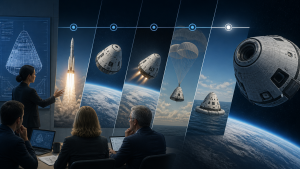
NASA and Boeing outlined a phased return plan for the CST-100 Starliner spacecraft on 28 September 2026. The plan includes an uncrewed Starliner-1 mission, a crewed Starliner-2 mission, and possible additional flights to the International Space Station (ISS).
Starliner programme
The CST-100 Starliner is a crew capsule developed by Boeing under NASA’s Commercial Crew Programme. The spacecraft is designed for crew transport to low-Earth orbit and routine crew exchange missions to the ISS. Starliner uses a service module with propulsion systems and a crew module for astronauts.
Planned mission sequence
Starliner-1 is targeted for launch no earlier than December 2026 or January 2027. The uncrewed flight will test remediation measures, thermal performance, propulsion data, and system readiness after the 2024 Crew Flight Test. Starliner-2 is planned for 2028, with Boeing targeting the middle of that year, and NASA astronaut Woody Hoburg has been assigned as mission commander.
Propulsion and launch vehicle changes
The revised plan includes certification work for the Vulcan Centaur rocket for Starliner missions. NASA, Boeing, and United Launch Alliance are working on this step because the Atlas V rocket has limited remaining service life. The Atlas V has been used for earlier Starliner launches.
Important Facts for Exams
- The CST-100 Starliner is one of the two crew vehicles developed under NASA’s Commercial Crew Programme, alongside SpaceX Crew Dragon.
- The Crew Flight Test in June 2024 carried NASA astronauts Butch Wilmore and Suni Williams.
- The Starliner returned uncrewed in September 2024 after propulsion issues during the 2024 mission.
- An independent Program Investigation Team identified 61 recommendations for hardware and system changes.
Technical issues and corrective actions
The June 2024 crewed flight faced helium leaks and failure of five reaction control system thrusters. Wilmore and Williams returned to Earth on a SpaceX Crew Dragon in March 2025 after spending more than nine months on the ISS. Boeing has introduced hardware changes, including thermal modifications and a thruster valve design change to address corrosion-related issues.
ISS crew transport context
The ISS is a modular space station in low-Earth orbit used for long-duration human spaceflight and microgravity research. Crew exchange missions to the ISS are part of NASA’s commercial crew transport model. The Starliner programme includes options for a fifth and sixth flight to the station.
| Related | |
|---|---|