Mid-Day Meal Scheme
Introduction
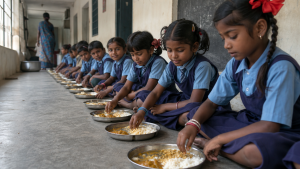
The Mid-Day Meal Scheme is one of the world’s largest school feeding programmes. It provides free, hot cooked meals to children in eligible schools to reduce classroom hunger, improve nutrition, and support school attendance.
Officially renamed Pradhan Mantri Poshan Shakti Nirman (PM POSHAN) in September 2021, the scheme remains an important Centrally Sponsored Scheme under the National Food Security Act (NFSA), 2013.
Origin and Evolution
- 1920: The first recorded initiative was introduced in the Madras Corporation for a corporation school in Thousand Lights under the Justice Party administration.
- 1930: The scheme was implemented in Puducherry under French administration.
- 1962–63: Tamil Nadu Chief Minister K. Kamaraj launched a statewide meal programme in government primary schools.
- 1982: Chief Minister M. G. Ramachandran expanded it into the Nutritious Meal Programme in Tamil Nadu.
- August 15, 1995: The central scheme was launched as the National Programme of Nutritional Support to Primary Education (NP-NSPE) across 2,408 blocks for Classes I to V.
- November 28, 2001: The Supreme Court directed states to provide hot cooked meals instead of dry rations, with a minimum of 300 calories and 8–12 grams of protein.
- 2007: The scheme was extended to upper primary classes in Educationally Backward Blocks (EBBs) and later across all areas.
- 2013: It received statutory backing under Section 5 of the NFSA, 2013.
- September 2021: The scheme was renamed PM POSHAN and expanded to include Balvatikas (pre-primary children aged 3 to 5 years).
Coverage and Implementation
- The scheme covers government schools, government-aided schools, Local Body schools, Special Training Centres, and recognised madrasas and maqtabs under the Samagra Shiksha framework.
- It is implemented as a Centrally Sponsored Scheme with shared responsibility between the Centre and the States/UTs.
- The meals are provided on school days as free, hot cooked food.
- The scheme is designed to address classroom hunger, improve enrolment, increase attendance, and support retention.
- It also aims to improve the nutritional status of children and promote social equity through shared dining.
Nutritional Norms
| Category | Classes | Calories | Protein | Food Grains | Pulses | Vegetables | Oil & Fats |
| Primary | Balvatika & Classes I–V | 450 kcal | 12 grams | 100 grams | 20 grams | 50 grams | 5 grams |
| Upper Primary | Classes VI–VIII | 700 kcal | 20 grams | 150 grams | 30 grams | 75 grams | 7.5 grams |
Financial Structure and Support
- The funding pattern is 60:40 for standard States and Union Territories with legislature.
- For North-Eastern States, Himachal Pradesh, Uttarakhand, and Jammu & Kashmir, the sharing ratio is 90:10.
- For Union Territories without legislature, the Central Government provides 100% funding.
- The Centre also supplies 100% free food grains through the Food Corporation of India (FCI).
- Transportation cost for food grains is fully subsidised by the Centre.
- Cook-cum-helpers receive a monthly honorarium for 10 months in an academic year, shared by the Centre and the States.
Key Features and Community Participation
- School Nutrition Gardens (SNGs): Schools grow seasonal vegetables and greens to improve meal quality and encourage learning about agriculture.
- Tithi Bhojan: Community members provide extra items such as fruits, sweets, or milk on birthdays and festivals.
- Fortified food grains: Rice enriched with iron, folic acid, and vitamin B12 is used to address micronutrient deficiencies.
- Drought and disaster support: Hot cooked meals or food security allowances are provided during summer vacations in government-notified drought or disaster-affected areas.
- Cook-cum-helpers: The scheme supports local employment, especially for women from rural and economically weaker sections.
Significance
- Educational support: The scheme helps increase enrolment, reduce dropouts, and improve regular attendance, especially among girls and disadvantaged children.
- Hunger reduction: It reduces short-term hunger and helps students concentrate better in class.
- Health impact: It addresses protein-energy malnutrition, stunting, and wasting among school-going children.
- Supplementary health delivery: It is used as a platform for Weekly Iron and Folic Acid Supplementation (WIFS) and biannual deworming with Albendazole.
- Social inclusion: Shared meals encourage interaction across caste and community lines.
- Women’s livelihood: The scheme employs over 2.5 million cook-cum-helpers, many of whom are women from SC, ST, and economically weaker backgrounds.
Key Prelims Takeaways
- Old name: National Programme of Nutritional Support to Primary Education (NP-NSPE).
- Current name: Pradhan Mantri Poshan Shakti Nirman (PM POSHAN).
- Launch date: August 15, 1995.
- Legal basis: Section 5 of the National Food Security Act, 2013.
- Supreme Court direction: November 28, 2001, on cooked meals instead of dry rations.
- Primary norms: 450 calories and 12 grams protein.
- Upper primary norms: 700 calories and 20 grams protein.
Current General Studies comprises current-affairs-based, General Studies-rich study material on policies, laws, institutions, economy, science, environment, governance, international relations, and other varied but important topics for UPSC and State PSC Prelims examinations.
Fortnightly PDF compilations: Available here
Originally written on
April 29, 2026
and last modified on
September 5, 2026.
| Related | |
|---|---|