Major Health Financing and Insurance Schemes
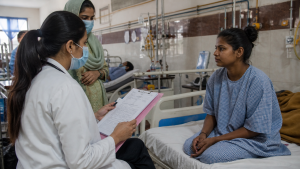
India’s health financing system combines tax-funded public insurance, employer-linked social security and government employee health cover. These schemes are designed to reduce out-of-pocket expenditure and improve access to institutional care, especially for vulnerable and formal-sector groups.
Ayushman Bharat PM-JAY: Architecture and Expansions
- Nodal agency: The National Health Authority (NHA), under the Ministry of Health and Family Welfare, manages both Ayushman Bharat Pradhan Mantri Jan Arogya Yojana (AB PM-JAY) and the Ayushman Bharat Digital Mission (ABDM).
- Coverage: The scheme provides cashless secondary and tertiary hospitalization cover of up to ₹5 lakh per family per year.
- Beneficiary base: It covers over 12 crore families, or roughly 55 to 60 crore people.
- Geographic reach: The scheme is operational across all 36 States and Union Territories after West Bengal joined in June 2026.
- Portability: Beneficiaries can take treatment at any empanelled hospital nationwide. As of late July 2026, inter-state portability had recorded 29.05 lakh admissions worth ₹8,383.97 crore.
- Senior citizens: Following a Cabinet decision on September 11, 2024, all senior citizens aged 70 and above are covered regardless of income or socio-economic status.
- Distinct entitlement: Eligible senior citizens receive a separate health card. If they are already part of an AB PM-JAY family, they get an additional top-up cover of up to ₹5 lakh per year, reserved only for them.
- Frontline workers: In March 2024, around 37 lakh families of ASHAs, Anganwadi Workers and Anganwadi Helpers were brought under the scheme.
Central Government Health Scheme (CGHS) Revamp
- Package-rate overhaul: On October 13, 2025, CGHS received its first major package-rate and structural revision in nearly 15 years.
- Revised pricing: The update introduced tier-based city pricing and revised rates for more than 2,000 medical procedures.
- Structural changes: The framework updated ward entitlement thresholds and modified outpatient department (OPD) consultation fees.
- Expanded coverage: It was extended to transgender children and dependent siblings of primary beneficiaries.
- Digital payments: Since April 28, 2025, all CGHS contributions and card renewals have to be processed only through the official CGHS portal.
- Bharatkosh replacement: Bharatkosh is no longer used for these CGHS financial transactions.
Employees’ State Insurance (ESI) Scheme Framework
- Administering body: The Employees’ State Insurance Corporation (ESIC) administers the ESI scheme.
- Operational basis: The scheme became operational under the Code on Social Security, 2020 on November 21, 2025.
- Applicability: It applies to non-seasonal establishments employing 10 or more persons.
- Wage ceiling: Coverage is mandatory for employees earning up to ₹21,000 per month, and up to ₹25,000 per month for persons with disabilities.
- Contribution rate: The total contribution is 4% of wages.
- Employer and employee share: Employers contribute 3.25% and employees contribute 0.75% of wages.
- Registration requirement: New ESIC registrations require Aadhaar verification and a passport-sized photograph of the insured person.
Comparison of Major Health Financing Schemes
| Parameter | AB PM-JAY | CGHS | ESI Scheme |
| Target group | Low-income families, senior citizens aged 70+, frontline health workers | Serving and retired Central Government employees | Formal-sector employees in non-seasonal establishments |
| Income threshold | No ceiling for 70+; based on SECC 2011 criteria for others | No income ceiling | Monthly wage up to ₹21,000 (₹25,000 for persons with disabilities) |
| Premium / contribution | Fully funded by Central and State governments | Monthly subscription based on pay level | Employee 0.75%; employer 3.25% |
| Implementing agency | National Health Authority (NHA) | Ministry of Health and Family Welfare | Employees’ State Insurance Corporation (ESIC) |
Key Prelims Takeaways
- NHA role: The NHA manages both AB PM-JAY and ABDM.
- PM-JAY cover: The scheme provides up to ₹5 lakh per family per year for hospitalization.
- Nationwide portability: Beneficiaries can use PM-JAY at any empanelled hospital across India.
- Senior citizen benefit: People aged 70 and above get separate PM-JAY coverage, even if their family is already enrolled.
- CGHS change: CGHS contributions and renewals are now processed only through the official CGHS portal.
- ESI contribution: The ESI contribution is 4% of wages, split between employer and employee.
- ESIC registration: Aadhaar verification and a passport-sized photograph are mandatory for new registrations.
Current General Studies comprises current-affairs-based, General Studies-rich study material on policies, laws, institutions, economy, science, environment, governance, international relations, and other varied but important topics for UPSC and State PSC Prelims examinations.
Fortnightly PDF compilations: Available here
Originally written on
March 19, 2026
and last modified on
September 5, 2026.
| Related | |
|---|---|