‘Women’s movement in India has not addressed the issues of women of lower social strata.’ Substantiate your view. (UPSC 2018)
India’s women’s movement has achieved notable gains in law and public awareness, but the criticism is largely valid: it has often under-addressed women of lower social strata such as Dalits, Adivasis, rural poor and informal workers.
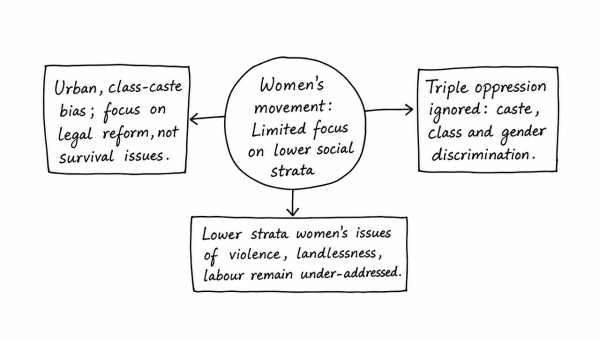
- Urban, class-caste bias: The mainstream agenda was largely shaped by urban, middle-class and upper-caste women. It focused on dowry, legal reform and workplace discrimination more than caste violence, landlessness, bonded labour, manual scavenging and survival needs.
- Triple oppression ignored: Lower-strata women face caste, class and gender discrimination together. Their experiences of sexual violence, deprivation and exclusion from dignified work were often treated as peripheral rather than central.
- Livelihood concerns neglected: For many rural and tribal women, land rights, forest access, displacement and unpaid agricultural labour matter more than formal equality in elite spaces, yet these issues received limited attention.
- Weak reach in informal economy: Since most poor women work in agriculture, home-based work, construction and domestic service, movement-led demands on office harassment or maternity benefits had limited relevance.
However, Dalit, Adivasi and grassroots collectives have increasingly expanded the movement’s scope, and a truly representative women’s movement must adopt an intersectional approach centred on caste, class, tribe, labour and livelihood.
Originally written on
August 31, 2026
and last modified on
August 31, 2026.