Women empowerment in India needs gender budgeting. What are the requirements and status of gender budgeting in the Indian context? (UPSC 2016)
Gender budgeting is a fiscal strategy to assess public spending from a gender perspective and align resources with women’s needs. In India, it is vital for translating constitutional equality into real outcomes, especially by reducing unpaid care work, improving safety, and raising women’s participation in the economy.
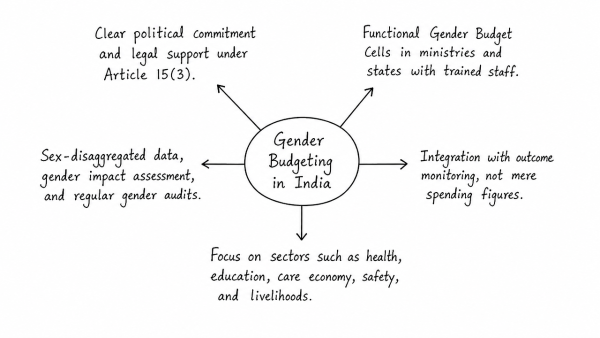
- Requirements
- Clear political commitment and legal support under Article 15(3).
- Functional Gender Budget Cells in ministries and states with trained staff.
- Sex-disaggregated data, gender impact assessment, and regular gender audits.
- Integration with outcome monitoring, not mere spending figures.
- Focus on sectors such as health, education, water, sanitation, transport, care services and livelihoods.
- Status in India
- Introduced in the Union Budget in 2005-06 through the Gender Budget Statement.
- The share of gender budgeting has risen steadily, with over 50 ministries/departments and some Union Territories now reporting allocations.
- The approach is divided into women-specific spending, pro-women schemes, and smaller gender-responsive allocations.
- Large programmes like PMAY-G, Jal Jeevan Mission and livelihoods missions include women-related components.
- Concerns
- Many allocations are indirect, making impact tracking difficult.
- GBCs often lack expertise and act as accounting units.
- Funding gaps, weak convergence and limited attention to structural issues remain major weaknesses.
Thus, gender budgeting has gained institutional depth in India, but its success depends on stronger data, sharper targeting, and genuine mainstreaming across all ministries.
Originally written on
August 30, 2026
and last modified on
August 30, 2026.