With reference to National Disaster Management Authority (NDMA) guidelines, discuss the measures to be adopted to mitigate the impact of recent incidents of cloudbursts in many places of Uttarakhand. (UPSC 2016)
Cloudbursts in Uttarakhand turn into deadly flash floods because of steep slopes, fragile geology, narrow valleys and intense road cutting. As per NDMA, the response must combine forecasting, land-use control, safer construction and community preparedness.
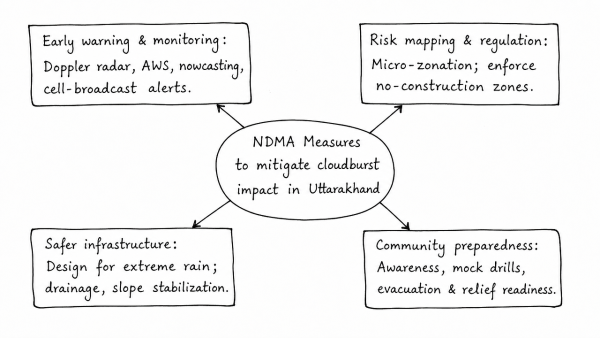
- Early warning and monitoring: Expand Doppler radar and automatic weather stations in high-altitude zones; use nowcasting, satellite data and cell-broadcast alerts for last-mile warnings to residents, pilgrims and tourists.
- Risk mapping and regulation: Prepare micro-zonation maps of landslide and flood-prone areas; strictly enforce no-construction zones on floodplains, unstable slopes and debris-flow channels.
- Safer infrastructure: Design hill roads, bridges and drainage to handle sudden runoff; provide retaining walls, check dams, debris traps and proper slope stabilisation through bio-engineering.
- Watershed and catchment treatment: Restore forests, protect springs and regulate quarrying, muck dumping and hill cutting to reduce erosion and debris load.
- Prepared communities: Train local volunteers, improve evacuation routes, identify shelters and hold frequent mock drills, especially in remote valleys and pilgrim routes.
A mountain-specific disaster management plan, backed by inter-agency coordination and strict enforcement, can greatly reduce loss of life, property and infrastructure in Uttarakhand.
Originally written on
August 31, 2026
and last modified on
August 31, 2026.