Why was there a sudden spurt in famines in colonial India since the mid-eighteenth century? Give reasons. (UPSC 2022)
Famines became more frequent in colonial India from the mid-eighteenth century because the rural economy was reorganised to serve colonial revenue and trade. This weakened peasant resilience and made harvest failures far more deadly.
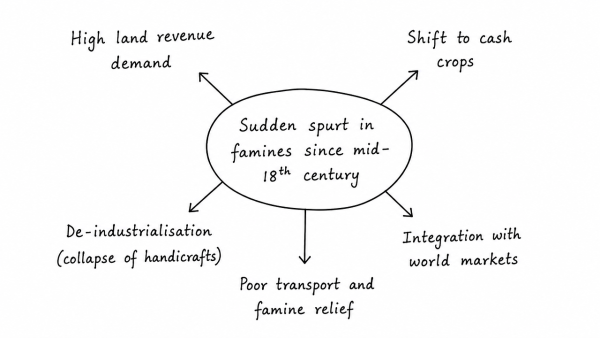
- High land revenue demand: Permanent Settlement, Ryotwari and Mahalwari systems fixed heavy cash taxes, forcing peasants to sell grain and lose food stocks.
- Shift to cash crops: Farmers were pushed towards indigo, opium, cotton and jute, reducing land for food crops.
- De-industrialisation: Collapse of handicrafts drove more people onto land, increasing pressure on already limited resources.
- Weaker local safety nets: Village grain reserves, common resources and community support systems declined under colonial rule.
- Laissez-faire and exports: The state avoided intervention in hoarding and speculation, while grain exports often continued during scarcity.
- Poor irrigation priority: Railways got more attention than canals, leaving rain-fed regions exposed to monsoon failure.
Thus, colonial policy turned climate shocks into repeated famines by removing buffers, reducing food availability and prioritising revenue over survival.
Originally written on
September 3, 2026
and last modified on
September 3, 2026.