Why was indentured labour taken by the British from India to other colonies? Have they been able to preserve their cultural identity over there? (UPSC 2018)
Indentured labour was taken by the British from India mainly to meet the severe labour shortage in plantation colonies after the abolition of slavery in 1833. It was a cheap, controlled and supposedly “free” contract system that protected colonial profits while keeping sugar, rubber and cotton estates supplied with workers.
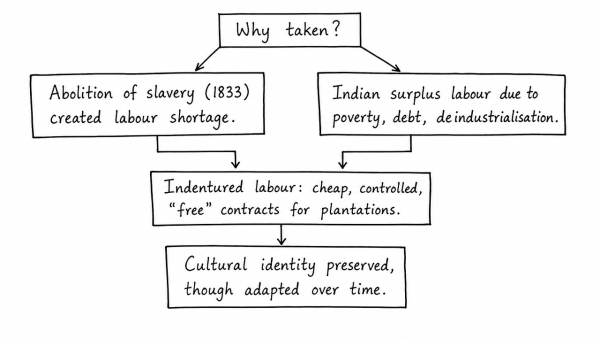
- Abolition of slavery created demand: Plantations in Mauritius, the Caribbean, Fiji, Malaya and elsewhere needed a new labour force.
- India provided surplus labour: Heavy land revenue, debt, rural poverty and deindustrialisation pushed peasants, artisans and landless people to seek work elsewhere.
- Recruitment was often deceptive: Arkatis and recruiters used false promises of wages and passage, and many workers did not fully understand the harsh conditions.
- Imperial control: Indenture tied labourers to fixed contracts, reducing bargaining power and ensuring steady plantation labour.
Have they preserved cultural identity? Yes, but in adapted form. Over generations, Indian descendants retained language, religion, food habits, songs and festivals, while also blending with local cultures.
- Language: New forms such as Fiji Hindi, Caribbean Hindustani and Sarnami emerged.
- Religion and festivals: Diwali, Holi and Shivratri remain strong markers of identity in many colonies.
- Social change: Caste barriers weakened and a shared “jahaji bhai” identity developed.
- Hybrid culture: Music and customs mixed Indian and local elements, creating distinct Indo-diasporic cultures.
Thus, indenture was a colonial response to labour needs and Indian distress. The migrants did not preserve their culture in a pure form, but they successfully sustained a resilient, hybrid identity that remains visible in many countries today.