Why is nanotechnology one of the key technologies of the 21st century? Describe the salient features of Indian Government’s Mission on Nanoscience and Technology and the scope of its application in the development process of the country. (UPSC 2016)
Nanotechnology is a key 21st-century technology because it manipulates matter at 1–100 nm, where new physical, chemical and biological properties emerge. This enables atomic-level design, higher surface area and quantum effects, improving performance, saving material and reducing cost.
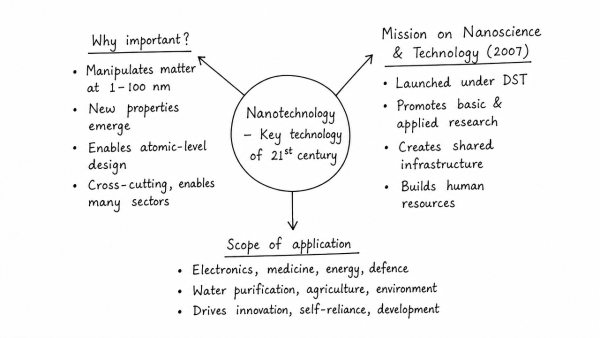
- Why it matters: It is a cross-cutting enabling technology with applications in electronics, medicine, energy, defence and water purification, and it complements AI, biotechnology and advanced computing.
- Mission on Nanoscience and Technology: Launched in 2007 under DST, the Mission promotes basic and applied research, creates shared infrastructure, builds human resources, and pushes innovations from lab to product through fellowships, training, networks and specialised laboratories.
- Developmental scope: Nano-fertilisers can improve nutrient efficiency; targeted drug delivery, diagnostics and biosensors can make healthcare precise; nano-filters can remove arsenic, fluoride and microbes; and nano-materials can strengthen semiconductors, solar cells, batteries and lightweight structures.
Thus, nanotechnology can boost productivity, public welfare and inclusive growth if supported by safe, affordable and indigenous innovation.
Originally written on
August 31, 2026
and last modified on
August 31, 2026.