Why has India’s conservation policy historically favored forest ecosystems over grasslands? Critically discuss the ecological implications of this bias.
India’s conservation policy has long treated forests as the main unit of nature protection, while grasslands were seen as empty, degraded or “wasteland”. This forest bias emerged from colonial ideas, timber-centric forestry and modern afforestation targets that rewarded tree cover rather than ecosystem diversity.
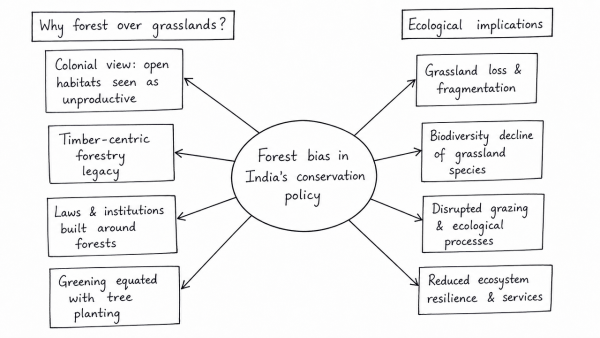
- Reasons for the bias
- Colonial administration linked conservation with trees, mapping open habitats as unproductive land.
- Post-independence laws and institutions were built around forest categories, not grassland ecology.
- Grasslands lacked separate legal status, dedicated management and monitoring.
- Climate and restoration policies often equated greening with planting trees, even in naturally open landscapes.
- Ecological implications
- Biodiversity loss: Tree planting and land conversion damage habitats of species such as the Great Indian Bustard, Lesser Florican, Indian wolf, blackbuck and grassland birds.
- Habitat simplification: Native open ecosystems are replaced by monocultures or dense woody cover, reducing plant and insect diversity.
- Carbon mismanagement: Grasslands store large amounts of carbon in soil and roots; converting them can release this stock and weaken climate resilience.
- Soil and water stress: Healthy grasslands reduce erosion, support moisture retention and help drought-prone areas remain resilient.
- Livelihood impacts: Loss of pasture undermines fodder security, pastoral systems and rural incomes.
The bias is therefore ecologically costly: it confuses woodedness with health, and restoration with afforestation. India needs ecosystem-specific policy that protects forests and recognises grasslands as equally vital, distinct and fragile landscapes.
Originally written on
September 23, 2026
and last modified on
September 23, 2026.