Why does the “awareness paradox” persist among digital consumers regarding online manipulative designs? Explain how this asymmetry undermines the principles of consumer justice in India.
The awareness paradox persists because dark patterns act faster than consumer caution. Even when users recognise manipulative interfaces, they face time pressure, defaults, hidden fees, and guilt-based prompts that exploit cognitive biases. Awareness does not remove the influence of poor design, weak transparency, or repeated nudges across the full user journey.
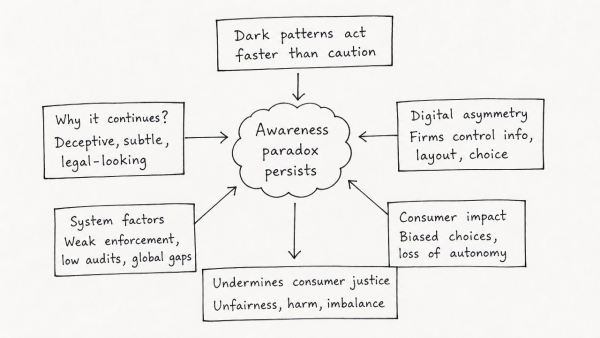
- Why it continues: deceptive design is subtle, often legal-looking, and difficult to spot in the moment.
- System factors: weak enforcement, low design audits, and global platforms create compliance gaps.
- Digital asymmetry: firms control information, layout, and choice architecture; consumers react with limited time and data.
This asymmetry undermines consumer justice in India by violating the right to informed choice, fair treatment, and meaningful consent. It also raises costs, fuels mistrust, and hurts vulnerable users most, especially those with lower digital literacy.
Thus, consumer justice requires more than awareness: it needs stricter regulation, transparent design, and swift redressal so that choice in the digital market is real, not engineered.