Why does classifying hyper-scale data centres as general building developments under India’s EIA rules pose ecological risks? Discuss with suitable examples how water usage efficiency can be institutionalized.
Classifying hyper-scale data centres as ordinary buildings under India’s EIA rules weakens scrutiny of facilities that function like 24×7 industrial systems with large water and energy footprints.
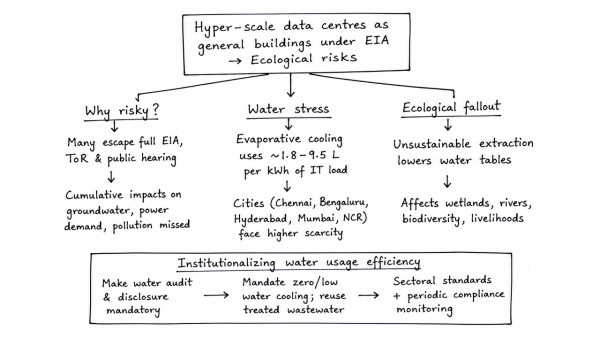
- Why risky: Many escape full EIA, Terms of Reference and public hearing, so cumulative impacts on groundwater, electricity demand and local pollution are missed.
- Water stress: Evaporative cooling can consume about 1.8–9.5 litres per kWh of IT load; in Chennai, Bengaluru, Hyderabad, Mumbai and NCR, this can intensify scarcity for households, farms and ecosystems.
- Ecological fallout: Unsustainable extraction lowers water tables, affects wetlands and community wells, and worsens competition in stressed basins; coastal clusters such as around Visakhapatnam can strain fragile local hydrology.
Institutionalising efficiency: Create a distinct EIA category for hyper-scale data centres; mandate water-impact assessment, public consultation, WUE benchmarks, annual disclosure of source/withdrawal/reuse/discharge, siting restrictions in critically stressed zones, and technologies such as liquid cooling, treated wastewater use, rainwater harvesting and on-site recycling; approvals, tariffs and incentives should be linked to verified reductions in freshwater use and higher reuse.
Originally written on
September 13, 2026
and last modified on
September 13, 2026.