Why do SC and ST entrepreneurs face persistent structural barriers in accessing formal credit? Critically discuss how institutional mechanisms like Stand-Up India can bridge this gap.
SC and ST entrepreneurs often remain outside the reach of formal credit not because of lack of enterprise, but because the credit system is designed around assets, paperwork and prior market success. Historical exclusion has created a cycle of low wealth, weak collateral, thin credit records and limited business networks.
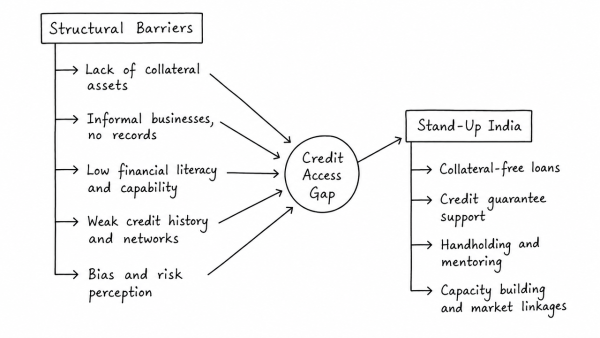
- Structural barriers: first-generation entrepreneurs often lack land, property or other assets to pledge. Many run informal businesses, which do not generate the records banks seek.
- Capability gaps: lower financial literacy, weaker access to mentors and difficulty in preparing bankable project reports reduce approval chances.
- Institutional bias: lenders may see new SC/ST ventures as riskier, while complex procedures, delays and subtle discrimination deepen exclusion.
- Market disadvantage: poor access to suppliers, buyers and information lowers business viability, which in turn affects perceived creditworthiness.
How Stand-Up India helps
- It targets greenfield enterprises by SC, ST and women borrowers, thus supporting first-time entrepreneurs.
- Loans are collateral-free under credit guarantee cover, easing the biggest entry barrier.
- It offers a composite loan for term needs and working capital, suited to new ventures.
- Handholding support through training and mentoring improves preparation, confidence and repayment capacity.
Critical limits
- Awareness remains uneven, especially in rural and remote areas.
- Sanction does not always translate into disbursal; procedural delays persist.
- Credit support alone cannot overcome weak market access, skills gaps and enterprise fragility.
Therefore, Stand-Up India is a useful corrective, but only as part of a wider ecosystem of mentorship, market linkages, financial literacy and simpler banking processes. To bridge the gap sustainably, credit policy must move from mere lending to full entrepreneurship support.
Originally written on
September 12, 2026
and last modified on
September 12, 2026.