“While the national political parties in India favour centralisation, the regional parties are in favour of State autonomy.” Comment. (UPSC 2022)
Indian federalism is neither fully centralised nor fully decentralised: the Constitution gives a strong Centre, yet States are vital democratic units. Party ideology, electoral base and access to power shape Centre-State preferences.
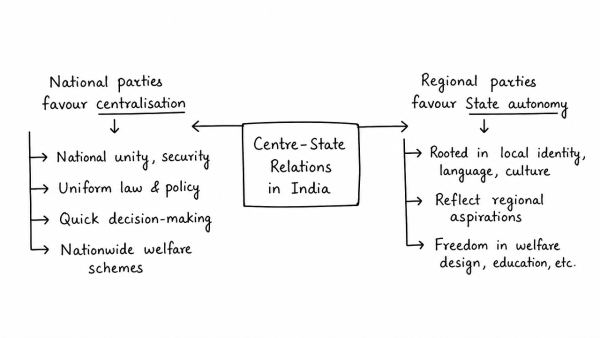
- National parties and centralisation: They often stress national unity, security, uniform law and policy, quick decision-making and nationwide welfare schemes. The Union List, emergency provisions and central roles in national interest make this outlook constitutionally plausible.
- Regional parties and State autonomy: Rooted in local identity, language, culture and regional aspirations, they seek more freedom in welfare design, education, administration and resource allocation. They resist excessive use of Governors, central agencies, conditional grants and one-size-fits-all policies.
- Limitations of the claim: It is not absolute. Regional parties may support strong central action in security, disasters or inter-State issues, while national parties may demand autonomy when they govern States or face central interference.
Hence, the statement is broadly correct but oversimplified; Indian politics reflects a shifting balance that requires cooperative federalism, not rigid centralisation or fragmentation.
Originally written on
September 3, 2026
and last modified on
September 3, 2026.