Whether the Supreme Court Judgement (July 2018) can settle the political tussle between the Lt. Governor and elected government of Delhi? Examine. (UPSC 2018)
The Supreme Court’s July 2018 judgment was a major constitutional correction in Delhi’s favour, but it could not fully end the tussle between the Lt. Governor and the elected government. It settled the principle of elected accountability, yet left structural ambiguities that kept conflict alive.
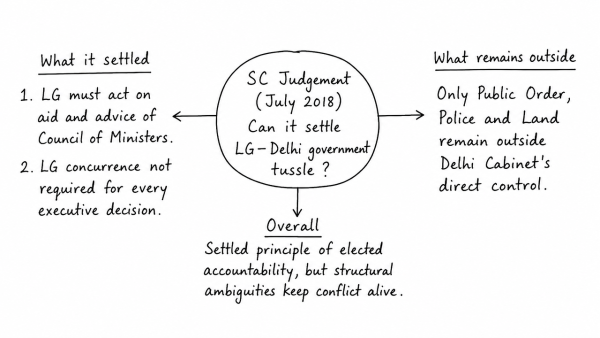
What it settled
- The LG must act on the aid and advice of the Council of Ministers in matters within Delhi’s competence.
- LG concurrence is not required for every executive decision.
- Only Public Order, Police and Land remain outside the Delhi Cabinet’s direct control under Article 239AA.
- The Court affirmed representative democracy, cooperative federalism and constitutional trust.
Why the dispute persists
- Article 239AA creates a hybrid arrangement: Delhi is neither a full State nor a normal Union Territory.
- Uncertainty remains over “services”, bureaucracy control, appointments and day-to-day administration.
- Overlapping authority of Parliament, the Union and the elected government creates recurring friction.
- Subsequent legislative and administrative moves have narrowed the practical effect of the judgment.
Examining the core issue
- The conflict is political and structural, not merely legal.
- The LG represents Union interests in the national capital, while the elected government seeks real executive space.
Thus, the 2018 judgment reduced arbitrariness and clarified broad principles, but a lasting settlement needs clearer legal demarcation, constitutional restraint and cooperative federalism.
Originally written on
September 1, 2026
and last modified on
September 1, 2026.