Whereas the British planters had developed tea gardens all along the Shivaliks and Lesser Himalayas from Assam to Himachal Pradesh, in effect they did not succeed beyond the Darjeeling area. Explain. (UPSC 2014)
The British extended tea cultivation from Assam to the Shivaliks and Lesser Himalayas, but Darjeeling alone became a lasting success. This was due to a rare combination of climate, soil, labour and connectivity that the western Himalayan belts could not match.
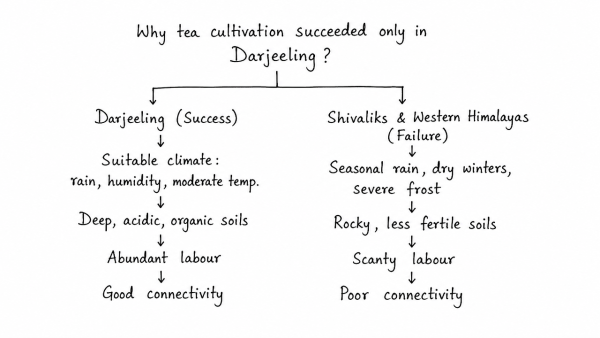
- Suitable climate in Darjeeling: heavy, well-distributed monsoon rain, high humidity and moderate temperatures favoured tea flushes.
- Unsuitable western conditions: the Shivaliks had seasonal rainfall, dry winters and severe frost, which damaged tea bushes.
- Better soils in Darjeeling: deep, acidic, organic soils supported commercial tea, unlike the rocky and less acidic soils of much of the west.
- Labour and settlement: Darjeeling could attract migrant plantation labour; the western hills had sparse, subsistence-based populations.
- Transport advantage: Darjeeling was linked to Kolkata by rail and road, reducing export costs; western belts remained remote.
- Shocks in the west: the 1905 Kangra earthquake further weakened the industry.
Thus, Darjeeling offered a stable plantation ecology and market access, while the western Himalayan region lacked the same natural and logistical advantages.
Originally written on
August 29, 2026
and last modified on
September 7, 2026.