What were the events that led to the Suez Crisis in 1956? How did it deal a final blow to Britain’s self-image as a world power? (UPSC 2014)
The Suez Crisis began with Egypt’s post-1952 assertion of sovereignty under Gamal Abdel Nasser. The immediate spark came when the US and Britain withdrew funding for the Aswan High Dam, after which Nasser nationalised the Suez Canal Company in July 1956.
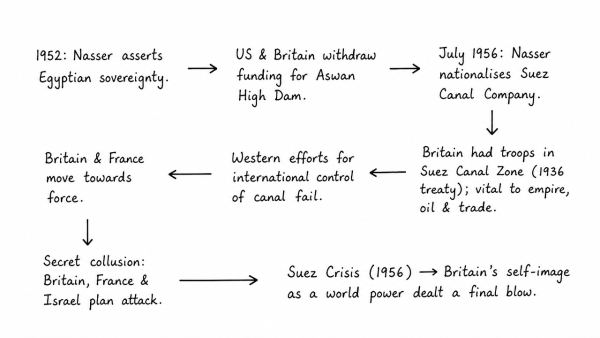
- Long-term tensions: Britain still had troops in the Suez Canal Zone under the 1936 treaty and saw the canal as vital to empire, oil and trade.
- Diplomatic failure: Western efforts to force international control of the canal failed, and Britain and France moved towards force.
- Secret collusion: Britain, France and Israel agreed at Sèvres that Israel would attack Sinai, giving Britain and France a pretext to intervene.
- Military action: In October 1956, the tripartite invasion began, but US and UN pressure forced a ceasefire and withdrawal.
The crisis shattered Britain’s self-image as a world power. It exposed dependence on the US for financial support, showed that Britain could not act independently, and marked the end of imperial prestige and great-power pretensions.
Originally written on
August 29, 2026
and last modified on
September 7, 2026.