What is wetland? Explain the Ramsar concept of ‘wise use’ in the context of wetland conservation. Cite two examples of Ramsar sites from India. (UPSC 2018)
A wetland is an area of marsh, fen, peatland or water, natural or artificial, permanent or temporary, with water that is static or flowing, fresh, brackish or saline. It also includes shallow marine water up to six metres deep at low tide.
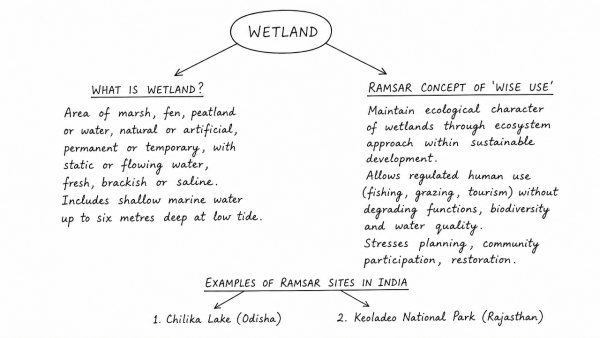
- Wise use: Ramsar’s concept means maintaining the ecological character of wetlands through an ecosystem approach within sustainable development.
- It allows regulated human use, such as fishing, grazing or tourism, so long as wetland functions, biodiversity and water quality are not degraded.
- It stresses planning, community participation, restoration and prevention of pollution, encroachment and over-extraction.
| Indian Ramsar sites | Significance |
| Chilika Lake, Odisha | Supports fisheries, birds and dolphins |
| Keoladeo National Park, Rajasthan | Managed wetland for migratory birds |
Thus, wise use links conservation with livelihoods, ensuring wetlands continue to provide water, biodiversity and climate resilience for present and future generations.
Originally written on
September 1, 2026
and last modified on
September 1, 2026.