What is water-use efficiency? Describe the role of micro-irrigation in increasing the water-use efficiency. (UPSC 2016)
Water-use efficiency means producing more crop output per unit of water consumed or applied. In simple terms, it reflects how effectively irrigation water is converted into biomass and yield, while minimising losses through evaporation, runoff and deep percolation.
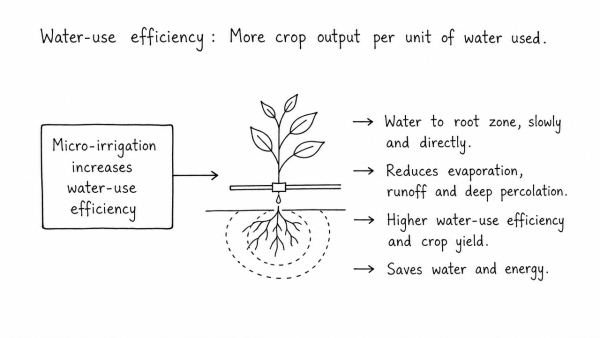
- Meaning: It is measured as crop yield per unit of evapotranspiration or per unit of water applied to the field.
- Why it matters: In India, agriculture uses most freshwater, but conventional flood irrigation has low efficiency.
Role of micro-irrigation
- Drip irrigation supplies water slowly and directly to the root zone, reducing evaporation and runoff. It can achieve very high application efficiency.
- Sprinkler irrigation distributes water more uniformly, especially in sandy, uneven or undulating land, and saves water compared to surface methods.
- Fertigation through drip lines improves nutrient uptake, reduces leaching and saves fertiliser.
- Other gains: Lower weed growth, less disease spread, reduced labour and lower energy use for pumping.
Thus, micro-irrigation raises water-use efficiency by delivering the right amount of water at the right place and time. It also improves productivity, supports climate-resilient farming and is essential for sustainable agriculture.
Originally written on
August 30, 2026
and last modified on
August 30, 2026.