What is water stress? How and why does it differ regionally in India? (UPSC 2019)
Water stress is a situation in which water demand exceeds available supply, or water is unusable due to poor quality. It may arise from physical scarcity or from economic scarcity caused by inadequate storage, distribution and treatment.
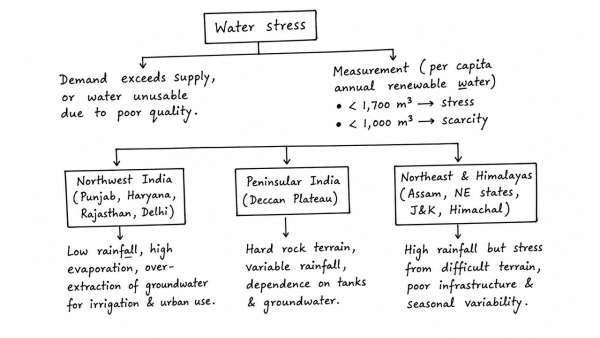
- Measurement: It is often assessed by per capita annual renewable water availability; below 1,700 cubic metres indicates water stress and below 1,000 cubic metres water scarcity.
- Regional pattern: Northwest India (Punjab, Haryana, Rajasthan, Delhi) faces severe stress due to low rainfall, high evaporation and over-extraction of groundwater for irrigation and urban use. Peninsular India (Maharashtra, Karnataka, Telangana, Tamil Nadu) suffers seasonal stress because rainfall is highly variable and hard-rock aquifers have limited storage and recharge. Eastern and north-eastern India receive higher rainfall, but local stress persists because of floods, poor storage, weak supply systems and pollution such as arsenic and fluoride. Himalayan areas also face local scarcity as springs dry up owing to deforestation, infrastructure growth and land-use change.
Water stress differs regionally because of uneven monsoon rainfall, monsoon dependence, geology, groundwater potential, cropping patterns, urbanisation and unequal access, with water-intensive crops in dry regions intensifying depletion.
Originally written on
September 1, 2026
and last modified on
September 1, 2026.