What is Cryptocurrency? How does it affect global society? Has it been affecting Indian society also? (UPSC 2021)
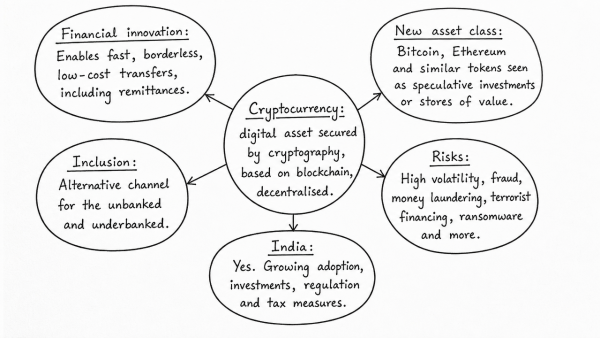
Cryptocurrency is a digital asset secured by cryptography and usually based on blockchain or other distributed ledgers. It is decentralised, so it is not issued or controlled by a central bank, and users can transfer it directly.
Global impact
- Financial innovation: Enables fast, borderless and often low-cost transfers, including remittances.
- New asset class: Bitcoin, Ethereum and similar tokens are treated by many as speculative investments or stores of value.
- Inclusion: Can provide an alternative channel for the unbanked and underbanked.
- Risks: High volatility, fraud, money laundering, terrorist financing, ransomware and tax evasion.
- Policy and environment: Forces states to balance innovation with consumer protection, taxation and AML rules, while energy-intensive mining raises ecological concerns.
Impact on India
- India has a large youth-driven retail crypto market and ranks among the major crypto-using countries.
- Many small investors have suffered losses due to sharp price swings and misleading schemes.
- Regulation has tightened through 30% tax on gains, 1% TDS on transfers, and AML obligations for exchanges.
- No single comprehensive law yet exists, so oversight is spread across agencies; the RBI’s digital rupee reflects support for a sovereign digital payment option.
Thus, cryptocurrency is reshaping payments, investment and regulation globally and in India, while also raising concerns over safety, legality and economic stability.
Originally written on
September 2, 2026
and last modified on
September 2, 2026.