What is allelopathy? Discuss its role in major cropping systems of irrigated agriculture. (UPSC 2016)
Allelopathy is the biochemical effect of one plant on another through chemicals released into the environment. These allelochemicals may suppress or sometimes stimulate seed germination, root growth and crop vigour.
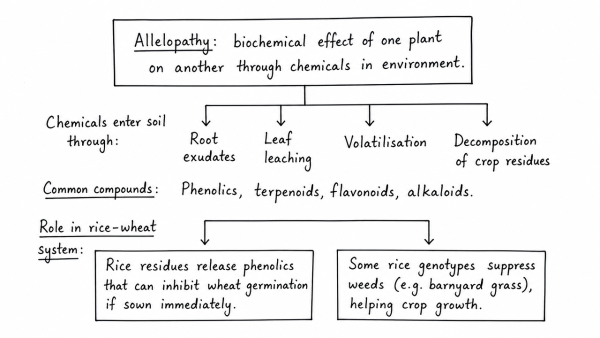
- How it works: Chemicals enter soil through root exudates, leaf leaching, volatilisation and decomposition of crop residues.
- Common compounds: Phenolics, terpenoids, flavonoids and alkaloids are major allelochemicals.
- Rice–wheat system: Rice straw and stubbles release phenolic compounds that can inhibit wheat germination if sowing follows immediately after harvest. At the same time, some rice genotypes suppress weeds like barnyard grass, helping reduce herbicide use.
- Sorghum and maize based systems: Sorghum roots release sorgoleone, a strong natural inhibitor of weeds. Sorghum extracts are used as bio-herbicides in irrigated crops such as wheat, maize and mungbean.
- Cotton systems: Cotton residues and root exudates can reduce weed emergence and support mulch-based moisture conservation in irrigated fields.
- Sugarcane systems: Trash mulch suppresses weeds, but continuous monocropping may lead to autotoxicity and poor crop growth.
Thus, allelopathy is both a constraint and a tool in irrigated agriculture. With proper residue management, crop rotation and use of allelopathic crops, it can improve weed control, reduce chemical inputs and support sustainable intensification.
Originally written on
August 30, 2026
and last modified on
August 30, 2026.