What is a quasi-judicial body? Explain with the help of concrete examples. (UPSC 2015)
A quasi-judicial body is an authority, other than a regular court, that decides disputes or determines rights by following legal principles and fair procedure. It has some powers of a court, but works within a limited field set by law.
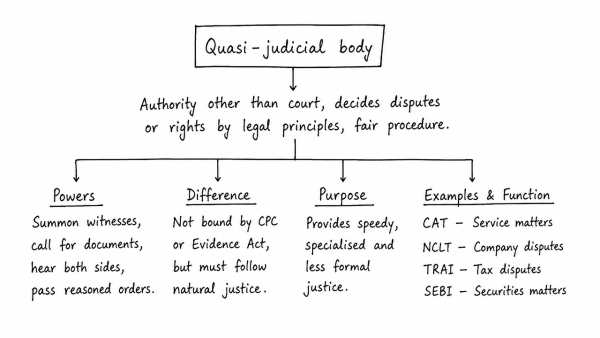
- Key features: It can summon witnesses, call for documents, hear both sides, and pass reasoned orders.
- Difference from courts: It is not strictly bound by the Code of Civil Procedure or the Indian Evidence Act, but must follow natural justice.
- Purpose: It provides speedy, specialised and less formal justice.
| Examples | Function |
| Election Commission | Decides disputes on symbols and party recognition |
| NGT | Hears environmental cases and imposes compensation |
| CIC | Hears RTI appeals and can penalise officials |
| NCLT | Adjudicates company and insolvency disputes |
Thus, quasi-judicial bodies bridge the gap between administration and courts, though their fairness depends on independence, expertise and accountability.
Originally written on
August 30, 2026
and last modified on
August 30, 2026.