What introduces friction in the ties between India and the United States is that Washington is still unable to find for India a position in its global strategy, which would satisfy India’s national self-esteem and ambitions. Explain with suitable examples. (UPSC 2019)
Frictions in India–US ties arise less from conflicting interests than from Washington’s difficulty in fitting India into its global strategy in a way that matches India’s self-image as an independent power.
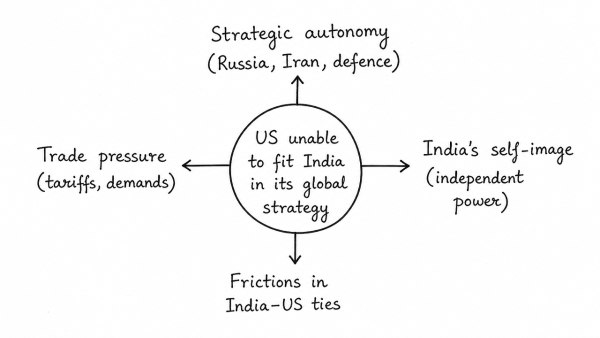
- Strategic autonomy: India insists on freedom of choice on Russia, Iran and defence procurement, while the US often expects policy alignment. India views such expectations as limiting its sovereignty.
- Trade pressure: US tariffs on Indian goods and repeated trade demands have made the partnership appear conditional, not equal, hurting India’s sense of dignity.
- Russia, Iran and Chabahar: India’s purchase of Russian crude for energy security and US sanctions pressure on Iran-linked projects like Chabahar have created friction over India’s regional connectivity goals.
- Pakistan factor: American engagement with Pakistan and any hint of mediation on Kashmir are seen in New Delhi as ignoring India’s stand that disputes with Pakistan are strictly bilateral.
- Limited recognition: India wants a larger role in the Indo-Pacific and global governance, but Washington often sees it mainly as a counterweight to China rather than a civilisational great power.
Thus, the core problem is a gap between India’s demand for status, autonomy and respect, and America’s tendency to place India within an unequal, utility-driven partnership.
Originally written on
September 1, 2026
and last modified on
September 1, 2026.