What do you understand by Run-of-river hydroelectricity project? How is it different from any other hydroelectricity project? (UPSC 2013)
Run-of-river hydroelectricity uses the natural flow and fall of a river to generate power. Water is diverted through a channel or tunnel to turbines and then returned to the river, with little or no large storage.
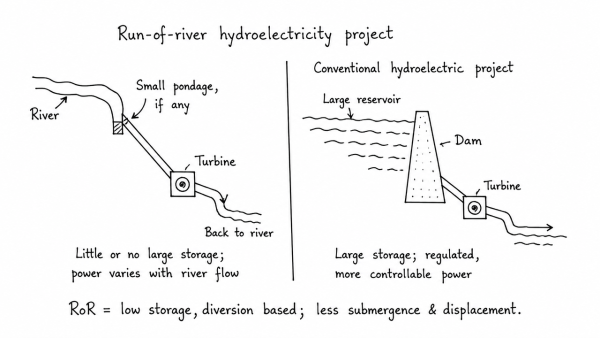
- Key feature: small pondage, if any, only for daily balancing.
- Difference: conventional projects use big dams and reservoirs to store water.
- Impact: RoR causes less submergence and displacement, but power output varies with river flow.
- Limitation: generation is seasonal and less controllable than reservoir-based hydro.
Thus, RoR is a low-storage, diversion-based hydropower project, unlike storage projects that provide firmer and more regulated electricity.
Originally written on
August 29, 2026
and last modified on
September 7, 2026.