What characteristics can be assigned to monsoon climate that succeeds in feeding more than 50 percent of the world population residing in Monsoon Asia? (UPSC 2017)
The monsoon climate is uniquely suited to support very dense populations because it combines warm temperatures, seasonal rain and fertile river plains. Its rhythm of wet and dry months shapes farming, settlement and food supply across Monsoon Asia.
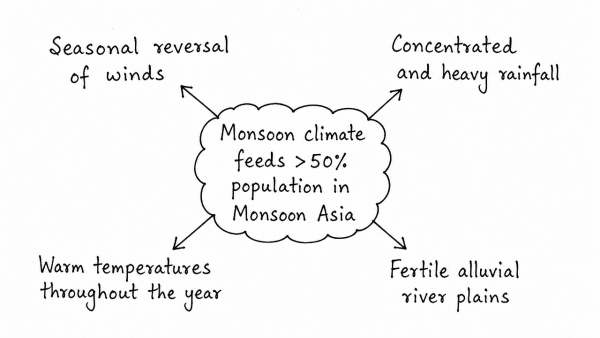
- Seasonal reversal of winds: The South-West monsoon brings rain in summer, while the North-East monsoon is generally dry. This clear alternation creates a dependable agricultural calendar for sowing, transplanting and harvesting.
- Concentrated and heavy rainfall: A large share of annual rain falls in a short period, often 3-4 months. This provides enough water for paddy fields and replenishes rivers, ponds and tanks.
- High temperatures throughout the year: Mean monthly temperatures usually stay above 18°C. This allows a long growing season and often permits double or triple cropping.
- Favourable for wet rice cultivation: Rice needs heat, moisture and standing water. Monsoon conditions match these needs well, and rice gives high calorie output per unit area.
- Fertile alluvial soils: Monsoon-fed rivers such as the Ganga, Brahmaputra, Mekong and Yangtze deposit silt on plains and deltas, making them highly productive and densely settled.
- Agro-climatic diversity: Relief barriers like the Himalayas and Western Ghats create very wet and rain-shadow regions. This supports crop variety and reduces dependence on a single crop.
Thus, the monsoon climate sustains intensive, labour-based agriculture with high land productivity. Its warmth, seasonal rainfall and fertile plains have made it the natural base for feeding a very large share of the world’s population in Monsoon Asia.
Originally written on
August 31, 2026
and last modified on
August 31, 2026.