What are the salient features of the National Food Security Act, 2013? How has the Food Security Bill helped in eliminating hunger and malnutrition in India? (UPSC 2021)
The National Food Security Act (NFSA), 2013 marked a shift from food relief to a legal right. It seeks to ensure access to adequate and quality food at affordable prices, while also strengthening nutrition support for women and children.
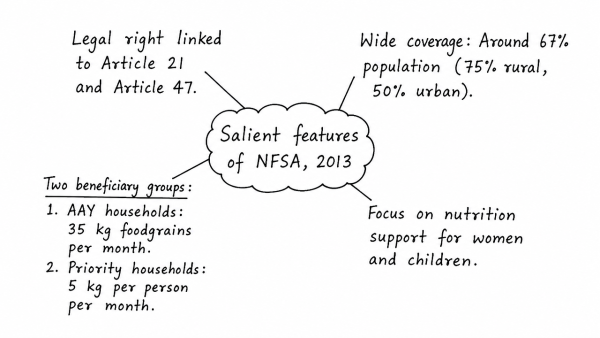
- Rights-based entitlement: Food security is made a legal entitlement, linked to Article 21 and Article 47.
- Wide coverage: Around 67% of the population is covered, including about 75% of rural and 50% of urban people.
- Two beneficiary groups:
- Antyodaya Anna Yojana households: 35 kg foodgrains per month.
- Priority households: 5 kg foodgrains per person per month.
- Nutrition support: Free meals for pregnant women and lactating mothers, and maternity benefit of at least ₹6,000.
- Child focus: Free meals for children aged 6 months to 14 years through anganwadis and schools.
- Women’s empowerment: The eldest adult woman is the head of the ration card household.
- Accountability: Grievance redressal mechanisms, food commissions and vigilance bodies are provided.
Impact on hunger and malnutrition:
- It has reduced the risk of starvation by creating a stable public distribution safety net.
- It improves food access for poor households, especially in droughts, inflation and other shocks.
- It supports maternal and child nutrition, the most critical stage for preventing stunting and wasting.
- Its school and anganwadi meals improve calorie intake and encourage regular attendance.
- During crises, it helped prevent large-scale food insecurity by ensuring grain supply to millions.
However, NFSA mainly addresses calorie hunger, not diet diversity. Its success in ending malnutrition depends on better delivery, nutrition-rich foods, and convergence with health, sanitation and livelihood schemes.
Originally written on
September 3, 2026
and last modified on
September 3, 2026.