What are the salient features of ‘inclusive growth’? Has India been experiencing such a growth process? Analyse and suggest measures for inclusive growth. (UPSC 2017)
Inclusive growth is broad-based, equitable and socially just growth that enables all sections—especially the poor, women, SC/STs, minorities, small farmers and informal workers—to share the gains of development.
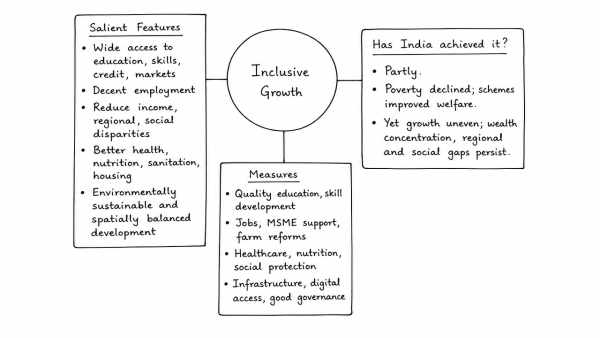
- Salient features: wide access to education, skills, credit and markets; decent employment; reduction in income, regional and social disparities; improved health, nutrition, sanitation and housing; and environmentally sustainable, spatially balanced development.
- Has India achieved it? Partly. Poverty has declined and schemes such as food security, PM-JAY, Jal Jeevan Mission and Swachh Bharat have improved welfare. Yet growth remains uneven, marked by wealth concentration, rural-urban gaps, youth unemployment, low skilling, informalisation and high out-of-pocket health costs.
- Measures: invest more in quality education, healthcare and skilling; generate labour-intensive jobs in manufacturing, MSMEs and rural non-farm sectors; strengthen social protection; expand credit, land, digital and market access for small producers; ensure better implementation of labour reforms and welfare schemes; and promote balanced regional development through infrastructure in backward areas.
Thus, India has moved towards inclusion, but sustained public investment, stronger employment creation and lower inequality are needed for truly inclusive growth.
Originally written on
August 31, 2026
and last modified on
August 31, 2026.