What are the research and developmental achievements in applied biotechnology? How will these achievements help to uplift the poorer sections of the society? (UPSC 2021)
Applied biotechnology in India has moved from laboratory success to practical solutions in health, agriculture and industry, with the key aim of turning science into affordable products that address poverty, malnutrition and low productivity.
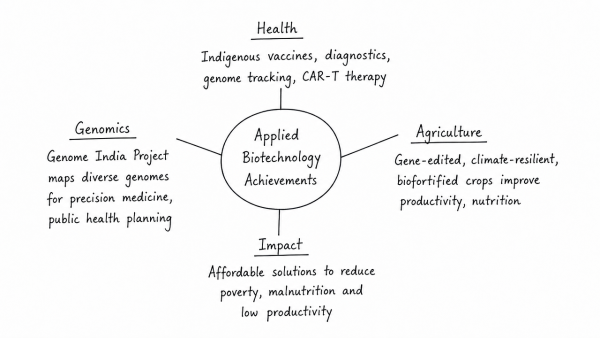
Research and developmental achievements
- Health: Indigenous vaccines, rapid diagnostics, genome-based disease tracking and cell therapy have advanced; the first home-grown CAR-T therapy, NexCAR19, is a major milestone in cancer care.
- Genomics: The Genome India Project has mapped diverse Indian genomes, supporting population-specific precision medicine and public health planning.
- Agriculture: Gene-edited, climate-resilient and biofortified crops have improved yield, nutrition and resistance to pests, drought and heat stress.
- Industry: Biofuels, biofertilisers, biopesticides, biogas and waste-to-wealth technologies are promoting cleaner production and rural enterprise.
Impact on poorer sections
- Affordable diagnostics, vaccines and domestic therapies reduce out-of-pocket health spending.
- Biofortified crops help fight anaemia and hidden hunger among children, women and the poor.
- Better seeds and bio-inputs raise farm income and lower crop losses for small farmers.
- Biotech-based rural enterprises create jobs for youth and women, while biogas and waste management improve sanitation and reduce indoor pollution.
Thus, applied biotechnology can uplift poorer sections through better health, nutrition, livelihoods and environmental quality, provided access is made affordable through public investment, extension and last-mile delivery.
Originally written on
September 3, 2026
and last modified on
September 3, 2026.