What are the present challenges before crop diversification? How do emerging technologies provide an opportunity for crop diversification? (UPSC 2021)
Crop diversification is vital for farm income, nutrition security and climate resilience, but Indian agriculture remains cereal-dominated in many regions.
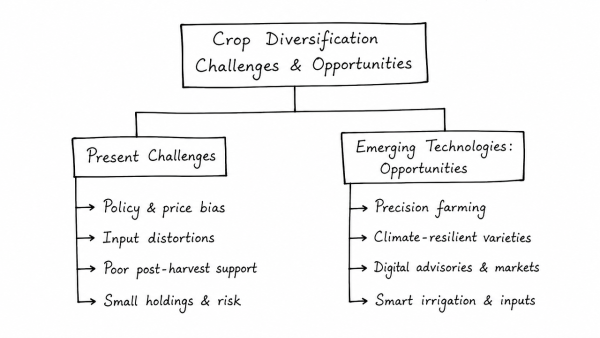
- Policy and price bias: MSP and assured procurement largely favour paddy and wheat, discouraging pulses, oilseeds, millets and horticulture.
- Input distortions: Cheap power, water and fertilisers promote water-intensive crops and make shifting to less resource-intensive crops unattractive.
- Poor post-harvest support: Inadequate cold storage, grading, processing and transport raise losses, especially for perishables.
- Small holdings and risk: Fragmented land, low capital and uncertain returns limit farmers’ ability to experiment with new crop mixes.
- Seed and extension gaps: Timely quality seeds, suitable varieties and advisory support remain weak for many diversified crops.
- Digital tools: Farmer IDs, digital surveys and databases can better target subsidies, credit and insurance, lowering risk for crop shifts.
- AI and remote sensing: Soil mapping, weather analytics and crop-suitability models help identify region-specific diversification options.
- Precision agriculture: Sensors, drones and smart irrigation reduce input use and make horticulture, pulses and seed crops more viable.
- Biotech: Climate-resilient, pest-tolerant and biofortified varieties can improve yield stability in diversified farming.
- Market technologies: e-markets, traceability and cold-chain systems improve access to buyers and cut losses.
Hence, policy correction and infrastructure must be matched with emerging technologies to make diversification profitable and risk-free for farmers.
Originally written on
September 3, 2026
and last modified on
September 3, 2026.