What are the major reasons for declining rice and wheat yield in the cropping system? How is crop diversification helpful to stabilise the yield of crops in the system? (UPSC 2017)
Rice-wheat dominance in the Indo-Gangetic Plains has raised output for decades, but the system is now showing signs of fatigue. Yields are falling because the production base has become ecologically stressed and highly vulnerable to weather and market shocks.
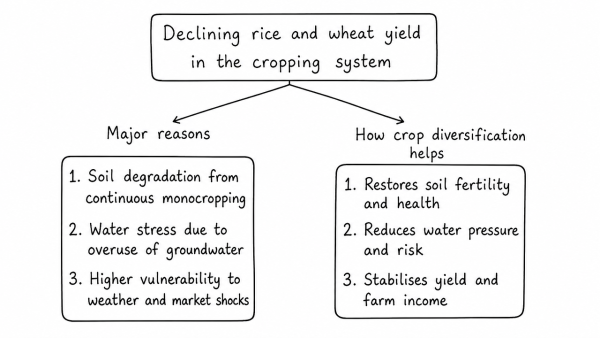
- Soil degradation: Continuous monocropping has mined nutrients and reduced soil organic matter. This weakens soil structure, lowers water-holding capacity and creates deficiencies of nitrogen, phosphorus, potassium and micronutrients.
- Water stress: Rice is often grown in water-scarce areas through overuse of groundwater. Falling water tables, higher pumping costs and salinity reduce productivity and make the system unsustainable.
- Climate stress: Rising temperatures, especially terminal heat during wheat grain filling, erratic monsoon behaviour and extreme rainfall events disturb crop growth and reduce yields.
- Pests and weeds: Repeated cultivation of the same crops encourages build-up of crop-specific pests, diseases and resistant weeds such as Phalaris minor.
- Pollution pressure: Air pollutants from nearby industrial activity can also depress crop performance and increase stress on plants.
| How diversification helps | Impact on yield stability |
| Rotating cereals with pulses, oilseeds and millets | Improves soil fertility and reduces nutrient mining |
| Including legumes | Fixes nitrogen naturally and restores soil health |
| Choosing crops suited to local rainfall and soils | Reduces water use and protects against drought |
| Breaking the rice-wheat sequence | Disrupts pests, diseases and weeds |
| Spreading risk across crops | Buffers income and output against climate shocks |
Thus, crop diversification is not only a soil-and-water saving strategy, but also a risk management tool. It stabilises system productivity, lowers input dependence and makes farming more resilient and sustainable.
Originally written on
August 31, 2026
and last modified on
August 31, 2026.