What are the major factors responsible for making rice-wheat system a success? In spite of this success how has this system become bane in India? (UPSC 2020)
The rice-wheat system became the backbone of Indian foodgrain production after the Green Revolution. It suited the agro-climatic conditions of the Indo-Gangetic plains and was strongly backed by policy, inputs and infrastructure.
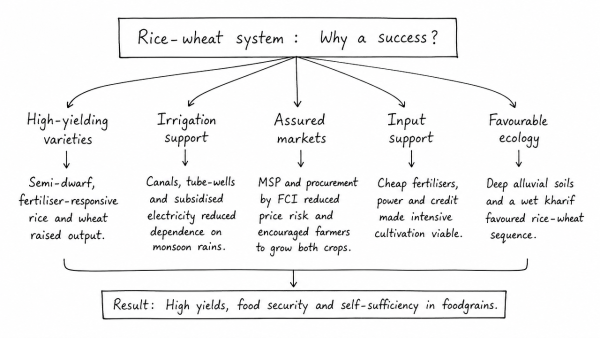
- Why it succeeded
| High-yielding varieties | Semi-dwarf, fertiliser-responsive rice and wheat varieties raised output sharply. |
| Irrigation support | Canals, tube-wells and subsidised electricity reduced dependence on monsoon rains. |
| Assured markets | MSP and procurement by FCI reduced price risk and encouraged farmers to grow both crops. |
| Input support | Cheap fertilisers, power and credit made intensive cultivation viable. |
| Favourable ecology | Deep alluvial soils and a wet kharif followed by a dry rabi season enabled double cropping. |
- Why it became a bane
- Rice is highly water-intensive. In many north-western states, groundwater extraction has far exceeded recharge, creating a serious water crisis.
- Continuous monocropping has degraded soils, reduced organic matter and caused nutrient imbalance due to excessive use of fertilisers.
- The short gap between paddy harvest and wheat sowing pushes farmers towards stubble burning, causing severe air pollution in north India.
- It has displaced pulses, oilseeds and millets, weakening crop diversity, nutrition and farm resilience.
- Flooded paddy fields emit methane, while heavy fertiliser use adds to greenhouse gas emissions.
- Large public procurement and subsidies have also created fiscal stress and huge grain stocks.
Thus, the rice-wheat system delivered food security and rural transformation, but its ecological costs are now high. The way forward lies in crop diversification, micro-irrigation, residue management, balanced fertilisation and stronger support for less water-intensive crops.
Originally written on
September 2, 2026
and last modified on
September 2, 2026.