What are the main socio-economic implications arising out of the development of IT industries in major cities of India? (UPSC 2021)
Development of IT industries in major Indian cities has reshaped urban economies and social relations. It has generated high-value employment and investment, but also widened inequalities and stressed urban infrastructure.
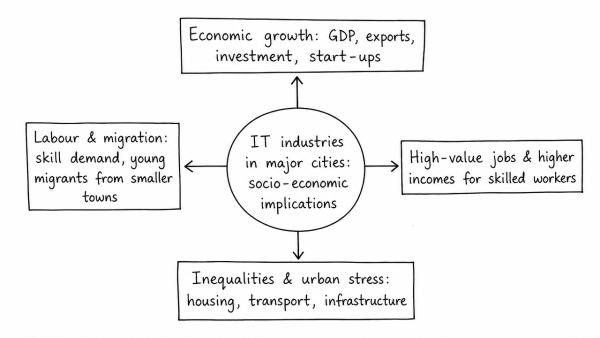
- Economic change: IT has boosted GDP, exports, start-ups and Global Capability Centres, especially in Bengaluru, Hyderabad, Pune and Gurugram. It has raised incomes for skilled workers and strengthened allied services such as real estate, transport and retail.
- Labour and migration: The sector has increased demand for engineers, coders, analysts and cyber specialists, while attracting young migrants from smaller towns. This has created a cosmopolitan workforce but also increased pressure on transport, water supply, housing and public services.
- Socio-spatial impact: Rising demand for offices and premium housing has pushed land prices and rents up, making cities less affordable and encouraging urban sprawl. It has also displaced some poorer groups and intensified traffic, waste and energy use.
- Social implications: IT has expanded formal employment opportunities for women and widened the middle class, but a dual city has emerged where highly paid professionals coexist with informal workers, deepening class divides and social distance.
Thus, IT-led urban growth is economically dynamic but socially uneven, making inclusive planning and sustainable infrastructure essential.
Originally written on
September 2, 2026
and last modified on
September 2, 2026.