What are the key features of the National Clean Air Programme (NCAP) initiated by the Government of India? (UPSC 2020)
The National Clean Air Programme (NCAP) is India’s first national, time-bound and multi-sectoral framework to reduce urban air pollution. Launched by the Ministry of Environment, Forest and Climate Change in January 2019, it aims to improve city-level air quality through coordinated action across sectors and institutions.
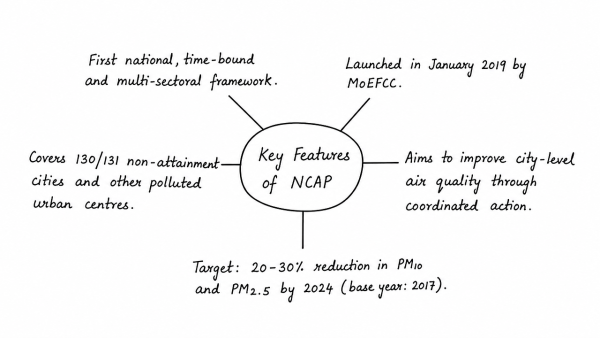
- Coverage and focus: It covers 130/131 non-attainment cities and other polluted urban centres across States and UTs.
- Clear targets: The programme originally aimed at a 20–30% reduction in PM10 and PM2.5 by 2024, with 2017 as the base year. The target has now been strengthened to a 40% reduction in particulate matter concentrations or achievement of the PM10 standard of 60 µg/m³ by 2025–26.
- Multi-level implementation: It works through cooperation among the Centre, State governments, Urban Local Bodies, CPCB and other line departments.
- City Action Plans: Each target city prepares local action plans based on its pollution sources and hotspots.
- Source-based approach: The programme promotes scientific source-apportionment studies to identify major causes such as road dust, vehicular emissions, construction dust, industry and waste burning.
- Funding support: It provides performance-linked grants and also uses funds from the 15th Finance Commission and the Control of Pollution Scheme.
- Convergence: NCAP links with schemes such as Swachh Bharat Mission-Urban, AMRUT, e-bus and urban greening initiatives.
- Monitoring and accountability: Progress is tracked through digital platforms such as PRANA and through annual clean air ranking of cities under Swachh Vayu Sarvekshan.
Thus, NCAP combines targets, finance, monitoring and city-specific planning. Its key strength lies in the collaborative and science-based approach, though success depends on stronger implementation, wider monitoring and sustained local capacity.
Originally written on
September 2, 2026
and last modified on
September 2, 2026.