What are the impediments in disposing the huge quantities of discarded solid wastes which are continuously being generated? How do we remove safely the toxic wastes that have been accumulating in our habitable environment? (UPSC 2018)
India’s solid waste problem is driven by rising urban waste, but disposal systems have not kept pace. Mixed waste, unsafe dumping and old landfill heaps make scientific treatment difficult and costly.
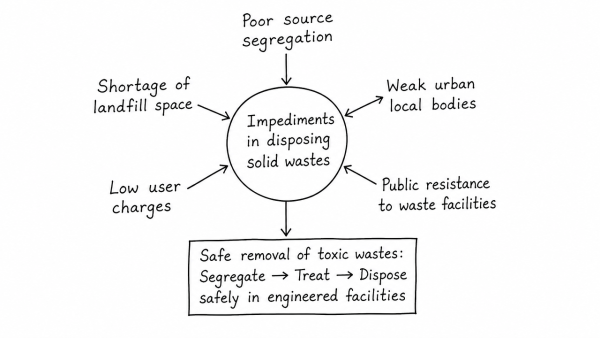
- Main impediments: poor source segregation, shortage of landfill space, weak urban local bodies, low user charges, and public resistance to waste facilities.
- Technical limits: mixed waste has high moisture and low calorific value, so composting, recycling and waste-to-energy plants work poorly.
- Legacy waste: old dumpsites generate leachate, methane and fire risks, while informal recycling is unsafe and unregulated.
- Safe removal of toxic waste: biomining of legacy dumps, followed by segregation into RDF, compostable fraction and inert material.
- Hazardous waste: secure treatment through stabilisation, high-temperature incineration, secure landfills, and strict tracking under extended producer responsibility.
- Site protection: phytoremediation and groundwater monitoring help clean contaminated soil and water.
Thus, source segregation, stronger civic capacity, modern treatment plants and strict regulatory enforcement are essential for safe and sustainable waste disposal.
Originally written on
September 1, 2026
and last modified on
September 1, 2026.