What are the forces that influence ocean currents? Describe their role in fishing industry of the world. (UPSC 2022)
Ocean currents are large-scale movements of seawater driven by a mix of external forces and internal ocean conditions. They redistribute heat, nutrients and marine life across the seas, and therefore shape major fishing zones of the world.
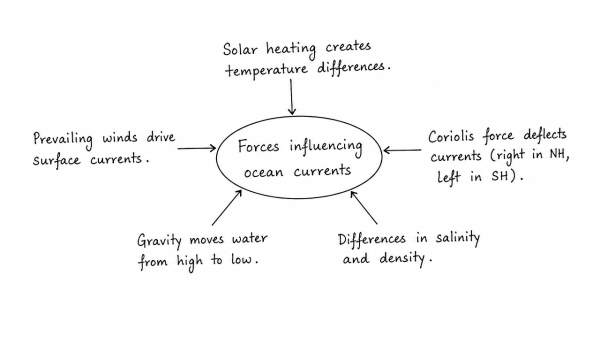
- Forces influencing ocean currents:
- Solar heating creates temperature differences and slight sea-level slopes, setting water in motion.
- Prevailing winds are the main force for surface currents, especially in the top 100 metres.
- Coriolis force deflects currents to the right in the Northern Hemisphere and to the left in the Southern Hemisphere.
- Gravity moves water down slopes formed by piling up of water or differences in density.
- Density differences caused by temperature and salinity drive deep currents and the global ocean conveyor.
- Continental barriers and seabed relief guide and redirect currents along coasts and basins.
- Role in fishing industry:
- Mixing of warm and cold currents creates nutrient-rich waters and abundant plankton, which attract fish.
- Upwelling zones bring cold, nutrient-laden deep water to the surface and support very high fish catches.
- Best fishing grounds occur where currents meet, such as the Grand Banks, off Japan, Peru, California, Canary and Benguela coasts.
- These eastern boundary upwelling systems occupy a tiny share of the ocean but contribute a large share of global marine catch.
- Climate events like El Niño weaken upwelling, reduce plankton, and cause sharp falls in fish harvests.
Thus, ocean currents are both a physical and economic force. They control marine productivity, determine the location of rich fishing grounds, and make fisheries highly vulnerable to climate change and overfishing.
Originally written on
September 3, 2026
and last modified on
September 3, 2026.