What are the continued challenges for women in India against time and space? (UPSC 2019)
Women in India continue to face layered disadvantages that shape both time and space. These are not isolated issues; they limit education, work, mobility, health and dignity, and keep women behind in public life and economic growth.
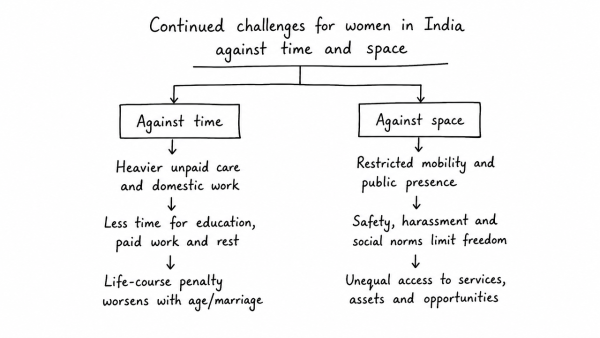
- Against time: Women bear a far heavier burden of unpaid domestic work and caregiving. Time use data show that they spend most of their day on household services, which leaves less time for paid work, study, rest and skill-building.
- Life-course penalty: The disadvantage widens with age and marriage. Young women are pushed out of education and jobs earlier than men, while care duties reduce their chances of entering formal employment.
- Work and income gap: Female labour force participation and worker participation remain much lower than men’s, showing that women’s time is not converted into economic opportunity on equal terms.
- Against space: Public spaces remain unsafe due to harassment, violence and poor policing. Fear of travel, especially at night, restricts women’s movement and access to work, markets and education.
- Workplace and village barriers: Many workplaces lack clean toilets, creches, safe transport and complaint mechanisms. In rural areas, limited land ownership weakens women’s control over assets, credit and decision-making.
- Digital exclusion: Women are still less likely to own phones, use mobile internet or access online services. Cyber harassment further shrinks their presence in digital space.
Thus, gender inequality in India is experienced through time poverty and spatial exclusion. Real progress needs safer public systems, shared care work, better transport, stronger workplace protection and greater control over assets and digital access for women.
Originally written on
September 1, 2026
and last modified on
September 1, 2026.