What are the challenges to our cultural practices in the name of secularism? (UPSC 2019)
Secularism in India means equal respect for all faiths, not erasure of culture. But in practice, cultural practices face pressure when the State or courts seek standardisation in the name of reform, neutrality or public order.
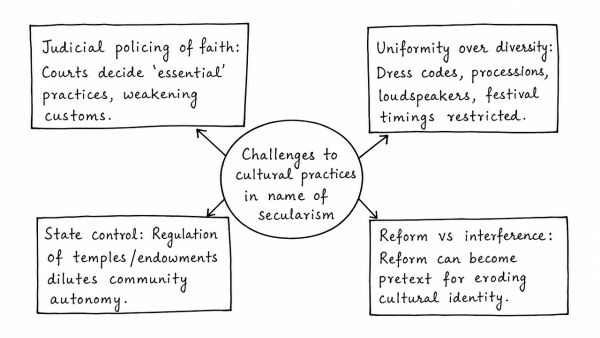
- Judicial policing of faith: The “essential religious practices” test can let courts decide what is truly religious, sometimes weakening long-standing customs and community autonomy.
- Uniformity over diversity: Dress codes, limits on processions, loudspeakers or festival timings may curb visible religious expression.
- State control: Regulation of temples and endowments can dilute community autonomy and create perceptions of unequal treatment.
- Reform vs belief: Social reform for gender equality or dignity may be viewed as intrusion if it ignores internal change within faiths.
Balanced secularism should protect constitutional values without reducing India’s cultural plurality to a uniform template.
Originally written on
September 1, 2026
and last modified on
September 1, 2026.