What are the areas of prohibitive labour that can be sustainably managed by robots? Discuss the initiatives that can propel research in premier research institutes for substantive and gainful innovation. (UPSC 2015)
Robots should increasingly handle labour that is dangerous, degrading or repetitive. In such tasks, technology can save lives, improve precision and free workers for safer, skilled jobs.
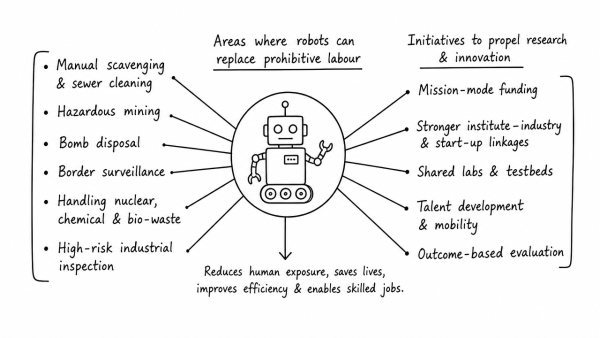
- Areas suited to robots: manual scavenging and sewer cleaning, hazardous mining, bomb disposal, border surveillance, handling nuclear, chemical and bio-hazardous waste, and high-risk industrial inspection.
- Why sustainable: robots reduce human exposure to toxic gases, radiation, blasts and extreme heat; they also improve efficiency in precision agriculture and utility inspection.
- Key enablers for research: mission-mode funding, stronger links between premier institutes, industry and start-ups, and testbeds for field trials.
- Institutional push: Technology Innovation Hubs, research parks, and public-private platforms can speed lab-to-market translation.
- Policy support: schemes for mechanised sanitation, robotics missions, and upskilling of workers as robot operators ensure social acceptance and gainful innovation.
Thus, the goal should be not replacement of labour alone, but humane automation that raises dignity, safety and productivity.
Originally written on
August 30, 2026
and last modified on
August 30, 2026.