What are ‘Smart Cities’? Examine their relevance for urban development in India. Will it increase rural-urban differences? Give arguments for ‘Smart Villages’ in the light of PURA and RURBAN Mission. (UPSC 2016)
Smart Cities are urban centres that use ICT, data, green technology and efficient planning to improve services, governance and quality of life. In India, they matter because rapid urbanisation is straining housing, transport, water, sanitation and environment.
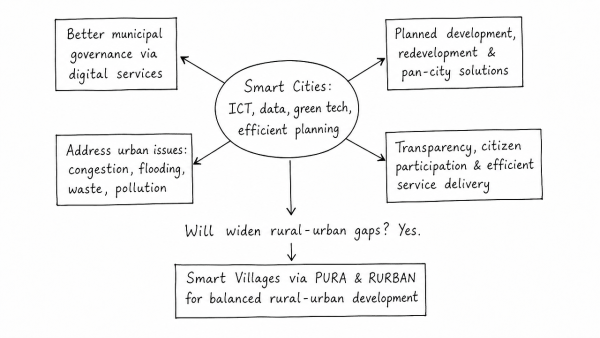
- Relevance for urban development
- Promote better municipal governance through Integrated Command and Control Centres and digital services.
- Support planned area-based development, redevelopment and pan-city solutions.
- Help address urban problems such as congestion, flooding, waste, heat islands and pollution.
- Improve transparency, citizen participation and efficiency in service delivery.
- Will they widen rural-urban gaps?
- Yes, if investments remain city-centric, deepening digital and infrastructure divides.
- They may attract skilled labour, capital and private investment away from villages.
- However, smart cities can also create backward linkages through markets, logistics, telemedicine and digital platforms.
- Why Smart Villages?
- PURA proposed physical, electronic, knowledge and economic connectivity to bring urban-like services to rural areas.
- RURBAN Mission seeks to develop clusters of villages with local economic growth and better infrastructure.
- Smart villages can reduce distress migration, generate non-farm jobs and support inclusive regional development.
Thus, smart cities are necessary for competitive urbanisation, but they must be matched by smart villages. Balanced investment in both is essential to reduce spatial inequality and achieve sustainable development.
Originally written on
August 30, 2026
and last modified on
August 30, 2026.