Vulnerability is an essential element for defining disaster impacts and its threat to people. How and in what ways can vulnerability to disasters be characterized? Discuss different types of vulnerability with reference to disasters. (UPSC 2019)
Vulnerability refers to the pre-existing conditions that make people, places and systems likely to suffer harm when a hazard occurs. It is not the hazard alone, but the extent to which exposure, sensitivity and low coping capacity turn a hazard into disaster.
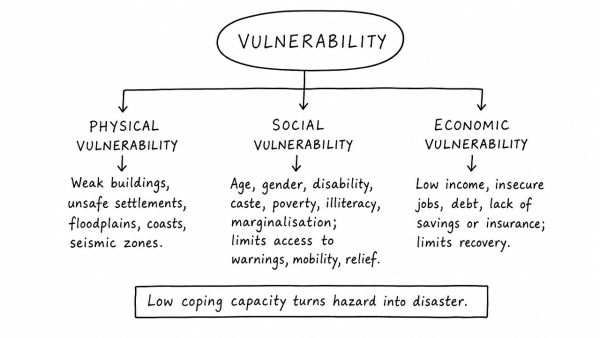
- Physical vulnerability: Weak buildings, unsafe settlements and location in floodplains, coasts or seismic zones increase damage.
- Social vulnerability: Age, gender, disability, caste, poverty, illiteracy and marginalisation reduce access to warnings, mobility and relief.
- Economic vulnerability: Low income, insecure jobs, debt and lack of savings or insurance limit recovery after crop loss, floods or cyclones.
- Environmental vulnerability: Deforestation, wetland loss, coastal erosion and degraded slopes weaken natural buffers and worsen landslides, floods and storm surges.
- Institutional vulnerability: Poor governance, weak planning, limited early warning and weak local capacity delay response and mitigation.
Thus, disaster vulnerability is multi-dimensional and often cumulative. Reducing it needs safer infrastructure, inclusive planning, livelihood security, ecosystem protection and stronger institutions.
Originally written on
September 1, 2026
and last modified on
September 1, 2026.