Vijayanagara architecture exemplifies the amalgamation of traditions with contemporary practices. Elucidate with examples. (UPSC 2026)
Vijayanagara architecture is a fine example of continuity with innovation. It preserved the core Dravidian temple tradition, but adapted it to imperial ambition, changing ritual needs and the military realities of the 14th–16th centuries.
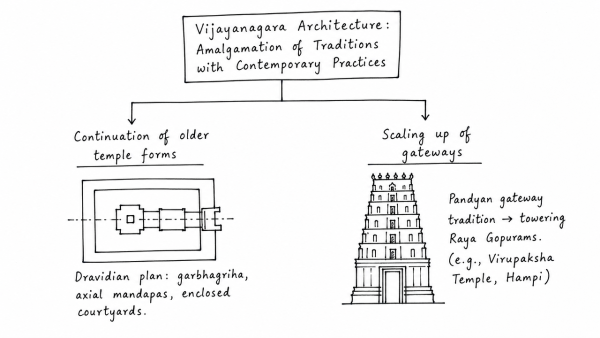
- Continuation of older temple forms: Temples kept the basic Dravidian plan of garbhagriha, axial mandapas and enclosed courtyards. The emphasis on axiality and enclosure shows continuity with Chola and Pandya traditions.
- Scaling up of gateways: The Pandyan gateway tradition was transformed into towering Raya Gopurams. The Virupaksha Temple at Hampi illustrates how these multi-storeyed towers became symbols of royal power, often dwarfing the sanctum.
- Hoysala and Chalukya influences: Vijayanagara craftsmen used ornate pillars, decorative brackets, yali motifs and star-like platforms, seen in temples such as the Vitthala complex. Step wells and water tanks also reflect earlier Deccan traditions, but on a grander scale.
- New ritual and public spaces: The period developed Kalyana Mandapas, long temple streets and bazaar streets for festivals, processions and trade. This made the temple both a religious and urban centre.
- Integration of Indo-Islamic elements: Secular structures like the Lotus Mahal, Elephant Stables and Queen’s Bath show arches, domes, stucco work and symmetrical planning borrowed from Deccan Sultanate architecture.
- Engineering and defence: Massive fortification walls, water channels, tanks and granite construction reflect practical response to warfare and a dry environment. The musical pillars of the Vitthala Temple show technical sophistication as well as artistic refinement.
Thus, Vijayanagara architecture did not merely copy the past. It reworked inherited forms with contemporary materials, functions and styles, creating a distinctive imperial idiom that was both traditional and modern for its time.
Originally written on
September 5, 2026
and last modified on
September 5, 2026.