Underline the institutional challenges in implementing interoperable national registries. How does robust carbon accounting prevent double-counting under international climate agreements?
Interoperable national registries are essential for transparent carbon markets, but their implementation faces serious institutional hurdles. Without common rules, data systems and trained staff, registries cannot reliably track transfers, ownership and retirements.
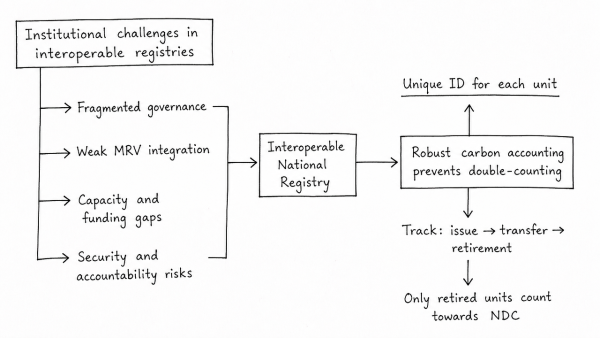
- Fragmented governance: More than 60 carbon standards use different formats and procedures, making data exchange difficult.
- Weak MRV integration: Standardised monitoring, reporting and verification with national inventories and ITMO records remains incomplete.
- Capacity and funding gaps: Many countries lack trained officials, secure systems and adequate finance for real-time registry links.
- Security and accountability risks: Poor cyber safeguards and unclear liability can undermine trust and market credibility.
Carbon accounting and double-counting are prevented through corresponding adjustments under Article 6 of the Paris Agreement. When a mitigation outcome is transferred, the host country subtracts it from its NDC account, while the acquiring country may count it once.
Unique identifiers, transparent reporting and registry interoperability ensure one credit is issued, transferred and retired only once. Thus, robust accounting protects environmental integrity and avoids inflated climate claims.