Troposphere is a very significant atmospheric layer that determines weather processes. How? (UPSC 2022)
The troposphere is the lowest and densest layer of the atmosphere, and almost all day-to-day weather occurs here. It contains most of the air, nearly all water vapour and aerosols, making it the main zone where clouds, rain, winds and storms form.
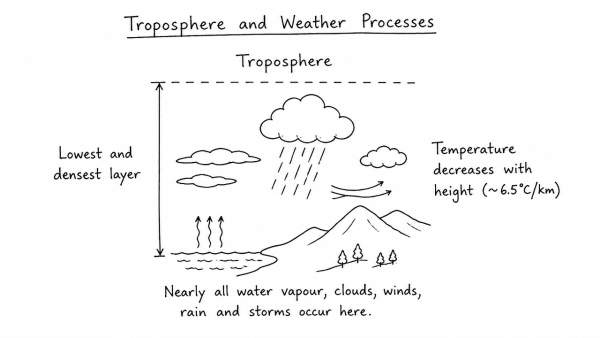
- Moisture and cloud formation: Because it holds almost all atmospheric water vapour, the troposphere supports evaporation, condensation and precipitation. Different cloud types, from stratus to cumulonimbus, develop here.
- Temperature decrease with height: In the troposphere, temperature falls with altitude at an average rate of about 6.5°C per km. This creates instability, so warm air rises, cools, condenses and produces convection, thunderstorms and rainfall.
- Surface influence: The lower troposphere, or planetary boundary layer, is directly affected by land, seas, vegetation and human activity. Heat, friction and moisture from the surface shape local winds, fog, dust and microclimate.
- Cyclones and fronts: Jet streams near the tropopause guide the movement of weather systems. They influence mid-latitude cyclones, frontal activity and the timing of seasonal wind shifts, including the monsoon.
- Energy and extreme events: Warming of the lower atmosphere strengthens the hydrological cycle, increasing the chances of intense rain, cloudbursts, drought spells and severe storms.
| Feature | Weather impact |
| Water vapour | Clouds and precipitation |
| Lapse rate | Convection and instability |
| Boundary layer | Local winds and humidity |
Thus, the troposphere determines weather because it is the active layer where surface energy, moisture and atmospheric circulation interact continuously. Its thermal structure and dynamic processes make it the chief arena of weather formation and change.
Originally written on
September 3, 2026
and last modified on
September 3, 2026.