To what extent, in your opinion, has the decentralisation of power in India changed the governance landscape at the grassroots? (UPSC 2022)
Decentralisation has changed grassroots governance in India substantially, but unevenly. It has created elected local institutions, widened participation, and improved planning, yet real power is still often limited by finance, staff shortages and state control.
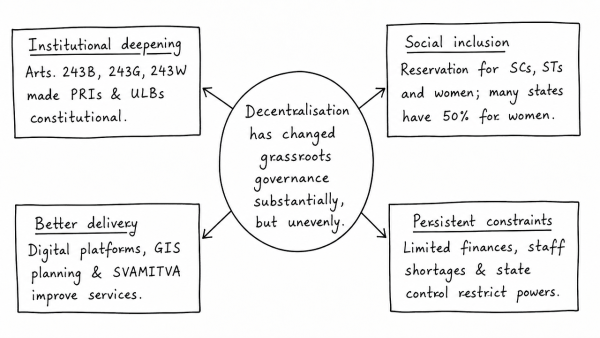
- Institutional deepening: Articles 243B, 243G and 243W made Panchayats and municipalities constitutional bodies with powers for local planning and social justice.
- Social inclusion: Reservation for SCs, STs and women has brought new groups into decision-making; many states now provide 50% reservation for women.
- Better delivery: Digital platforms, GIS-based planning and property mapping under SVAMITVA have improved records, transparency and access to credit.
- Persistent limits: Local bodies still depend heavily on grants, while own revenue remains very low. Delays in elections, weak Gram Sabhas and shortage of staff reduce autonomy.
Thus, decentralisation has democratised local governance and improved service design, but it has not yet fully transferred authority, resources and accountability to the grassroots. The governance landscape has changed in form and participation more than in true fiscal and administrative power.
Originally written on
September 3, 2026
and last modified on
September 3, 2026.