To what extent has the urban planning and culture of the Indus Valley Civilization provided inputs to the present day urbanization? Discuss. (UPSC 2014)
The Indus Valley Civilization has strongly influenced present-day urbanisation, especially in planning, sanitation and water management.
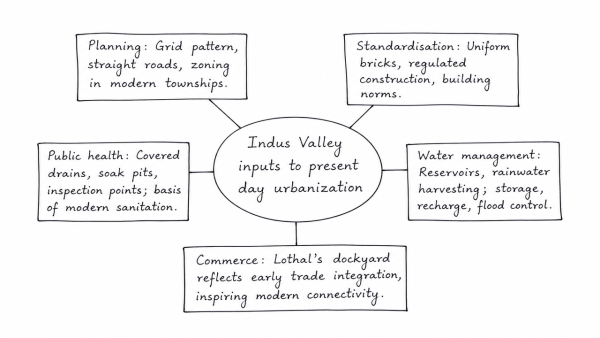
- Planning: Grid patterns, straight roads, right-angle crossings and separation of citadel and lower town inform modern zoning and planned townships.
- Standardisation: Uniform bricks and regulated construction anticipate building norms and standard materials.
- Public health: Covered drains, soak pits and inspection points show an advanced concern for hygiene, echoed in sewerage and sanitation systems.
- Water management: Dholavira’s reservoirs and rainwater harvesting offer lessons in storage, recharge and flood control.
- Commerce: Lothal’s dockyard reflects early integration of trade and transport, relevant to port-led development.
However, today’s cities are shaped more by industrialisation, mass migration, motor transport and digital infrastructure, so IVC’s legacy lies mainly in enduring principles of order, sanitation and sustainability.
Originally written on
August 29, 2026
and last modified on
September 7, 2026.