To what extent did the role of the moderates prepare a base for the wider freedom movement? Comment. (UPSC 2021)
The moderates did not launch a mass struggle, but they laid the first firm foundations of Indian nationalism. Their greatest contribution was to turn scattered grievance into organised political action and give the freedom movement a common platform.
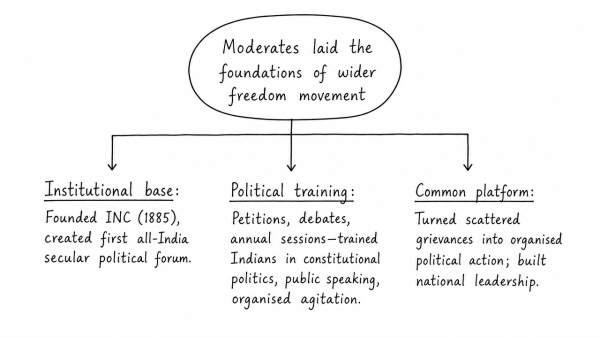
- Institutional base: By founding the Indian National Congress in 1885, they created the first all-India secular political forum. It brought together regional groups and helped build a national leadership.
- Political training: Through petitions, debates and annual sessions, they trained Indians in constitutional politics, public speaking and organised agitation. This educated middle class later led larger movements.
- Democratic ideas: They popularised representative government, civil liberties, rule of law and budget criticism. Such ideas widened political consciousness beyond local loyalties.
- Economic nationalism: Dadabhai Naoroji, R.C. Dutt and others exposed the drain of wealth, high taxes, military expenditure and the destruction of Indian industry. This gave nationalism a clear economic content.
- Reforms from pressure: Their efforts helped secure the Indian Councils Act, 1892, which expanded legislative councils and allowed discussion of the budget, showing that pressure politics could yield results.
Limits: Their appeal remained narrow, centred on urban, English-educated elites. Their faith in British justice and reliance on prayers, petitions and protests could not mobilise peasants, workers or the wider masses.
Thus, the moderates prepared the base of the wider freedom movement to a substantial extent by creating institutions, ideas and leadership. Yet the transformation into a truly mass national struggle came later, when extremists and Gandhi expanded that base to the people at large.
Originally written on
September 2, 2026
and last modified on
September 2, 2026.